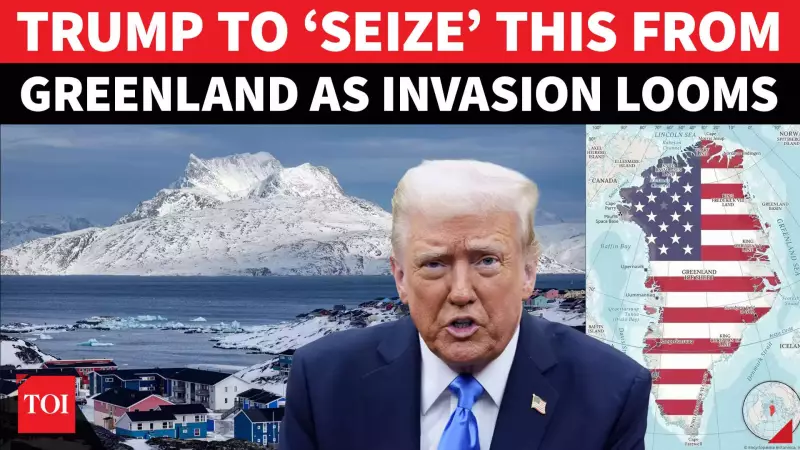
President Donald Trump's renewed and aggressive push to bring the vast Arctic territory of Greenland under United States control has sent shockwaves through European capitals and reignited deep-seated fears of American expansionism. This move comes in the wake of Washington's controversial actions in Venezuela, framing the island as critical to US national security interests. Alarmingly, Trump has refused to rule out the potential use of military force to achieve this goal, a stance that has drawn sharp warnings from European leaders and threatens the unity of the NATO alliance.
Why Greenland? The Strategic Prize in the Arctic
The core of Trump's interest lies in Greenland's immense geostrategic value. The island's location in the Arctic makes it a crucial piece in a new great power competition involving the United States, Russia, and China. It hosts vital missile-warning infrastructure and offers a commanding position for monitoring and controlling northern sea routes and airspace. Beyond military advantages, Greenland is believed to hold vast, untapped reserves of rare earth minerals and other natural resources, making it an economic prize for any nation that can secure influence there.
European Backlash and NATO Fractures
The US President's hardening rhetoric has not been received well across the Atlantic. European leaders, already uneasy from the Venezuela operation, view this as a brazen act of territorial ambition that upends decades of established international law and norms. Critics argue that such a bid, especially one that entertains the use of force against a peaceful Danish territory, could fundamentally fracture NATO unity. The alliance, built on mutual defense and shared values, finds itself strained by Washington's unilateral approach to securing its interests.

A Global Power Struggle Intensifies
The Greenland issue is no longer a fringe topic but is now at the center of a global power realignment. Russia has been steadily increasing its military and economic footprint in the Arctic, while China has declared itself a "near-Arctic state" and is investing heavily in polar research and infrastructure. Trump's overt move for Greenland is seen as a direct counter to these ambitions, aiming to secure American dominance in a region growing more accessible due to climate change. The situation threatens to reshape the entire balance of power in the High North, with potentially global repercussions.
As the situation develops, the world watches to see if Trump will act on his threats. The bid for Greenland stands as a stark test of international order, challenging alliances and setting a precedent for how major powers might pursue territorial and strategic gains in the 21st century. The coming months will reveal whether diplomacy can prevail or if the Arctic is destined to become a new zone of confrontation.