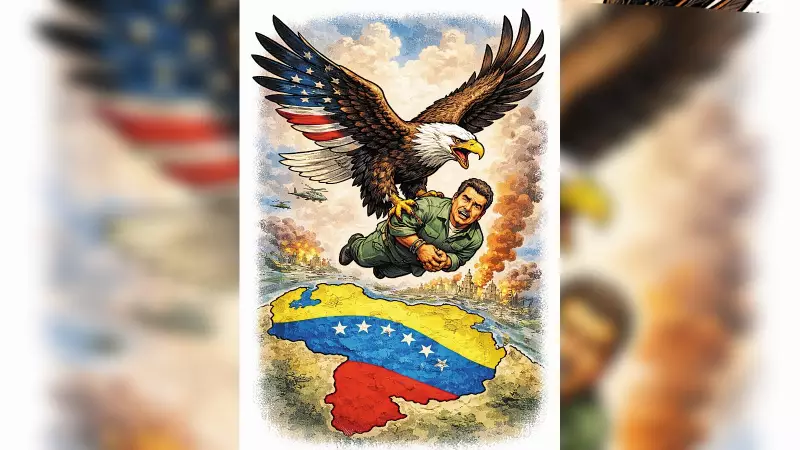
The dawn of 2026 witnessed a seismic geopolitical event that sent shockwaves across the globe. US special forces executed a daring operation leading to the capture of Venezuelan President Nicolás Maduro. This bold move, orchestrated by the Donald Trump regime, has ignited fierce debate, crystallising around the newly termed "Donroe Doctrine." While the streets of Caracas saw limited protests from pro-Maduro factions and attacks by armed colectivos, a broader, more complex political realignment is underway across Latin America.
The Unilateral Precedent: America's History of Defying International Norms
Legally, the Trump administration's intervention in Venezuela stands in clear violation of established international law. It also underscores the perceived impotence of global multilateral bodies like the United Nations and the International Court of Justice. However, this action is not an isolated incident in US foreign policy history.
From the invasion of Grenada in 1983 to topple a communist government, to the Panama operation in 1989 that captured Manuel Noriega, the US has a long record of unilateral military action. The 2003 Iraq war under George W. Bush proceeded without UN sanction, mirroring Trump's earlier strikes on Syria and Iran. The 2011 raid in Abbottabad that eliminated Osama bin Laden was conducted without seeking Pakistan's permission. In each case, global reaction was split between condemnation and tacit or open support.

The current scenario in Latin America reflects this dichotomy. Beyond the righteous indignation voiced in international media studios, the regional populace presents a more nuanced, often muted response. This silence is deeply rooted in the shifting power dynamics and internal crises plaguing the resource-rich continent.
The Pink Tide Recedes: A Region Weary of Violence and Instability
Latin America's political landscape has been shaped by distinct waves over the past eighty years. The 1959 Cuban Revolution led by Fidel Castro ushered in an era of left-wing authoritarian rule, drawing nations like Brazil, Argentina, Chile, and Bolivia into its orbit and fuelling Cold War-era anti-Americanism. A wave of US-backed democratisation followed in the 1980s and '90s.
The new millennium saw the rise of the "Pink Tide," a left-leaning wave with leaders like Hugo Chávez in Venezuela, Lula da Silva in Brazil, and Evo Morales in Bolivia. However, the last two decades have been marred by a descent into lawlessness. The region has become a global epicentre for the narcotics trade, with Bolivia, Peru, and Colombia producing the coca for thousands of tonnes of cocaine. Powerful drug and weapon cartels have amassed enormous wealth, leaving ordinary citizens to bear the brutal brunt of escalating violence and insecurity.
The Conservative Resurgence: Trump's Gambit Finds Fertile Ground
It is against this backdrop of pervasive fear and resentment that a new conservative wave is gaining formidable strength. Since returning to power in January 2025, the Trump administration has sharply focused on Latin America, declaring wars on drug cartels and illegal immigration. Strategic moves, like extending a massive $20 billion bailout to Javier Milei's conservative government in Argentina, have signalled a clear alignment.
The political data confirms the trend. Ecuador re-elected its conservative president, Bolivia ended two decades of communist rule, and right-wing parties are ascendant in Brazil, Colombia, Costa Rica, and Peru. Crucially, the annual Latinobarómetro poll reveals that right-wing support has hit a two-decade high in 18 countries. In a telling ranking, El Salvador's tough-on-crime conservative leader Nayib Bukele emerged as the region's most popular president, while Nicolás Maduro ranked last.
Thus, while Trump's action may be indefensible under international law, it appears to be a calculated power play that resonates with a significant, disillusioned segment of Latin American society. The ideological and geopolitical game is shifting, and for now, the Trump regime seems to be capitalising on the continent's conservative tide, turning popular discontent over drugs, violence, and insecurity into a strategic advantage.