

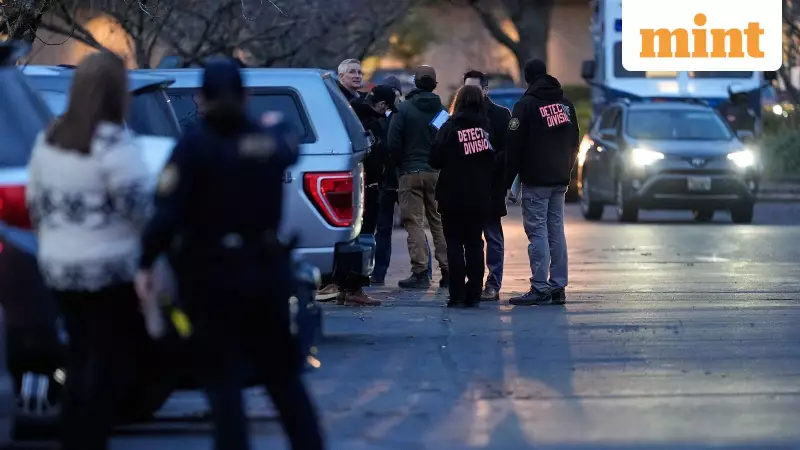
Tensions surrounding the United States' immigration enforcement policies have sharply escalated, following two separate shootings involving federal officers within two days. These incidents have dramatically widened the rift between state and federal authorities, sparking widespread protests and accusations of overreach.
Two Cities, Two Conflicting Narratives
The situation intensified on Wednesday in Minneapolis, Minnesota, where a 37-year-old mother, Renee Nichole Good, was fatally shot by an officer from Immigration and Customs Enforcement (ICE). The very next day, on Thursday, a U.S. Border Patrol agent in Portland, Oregon, shot and wounded a man and a woman. In both cases, Democratic state officials and federal authorities presented starkly different accounts of what transpired.
Minnesota's investigators stated they were deliberately excluded from the federal probe into Good's death. Similarly, Portland's local officials, while urging calm, said they could not independently verify the federal government's version of the shooting in their city. This lack of transparency has fueled public anger and distrust.

Protests Erupt and National Guard Put on Alert
In response to the Minneapolis shooting, hundreds of demonstrators gathered on Thursday, chanting "shame" and "murder" at armed, masked federal officers. The officers reportedly used tear gas and pepper balls to disperse the crowd. Minnesota Governor Tim Walz, anticipating further civil unrest, has placed the state's National Guard on alert.
"I feel like we're at a turning point. I can't say it enough, but things have got to change," said 52-year-old Minneapolis protester Rachel Hoppei. She added, "We don't want you... You have no right to be here. You're destroying our communities." In Portland, police reported six arrests during protests near an ICE building.
Divergent Accounts of the Critical Moments
The core of the conflict lies in the disputed facts of the Minneapolis case. Federal officials, including Vice President JD Vance, alleged that Good attempted to run over the ICE officer, calling her actions an "attack" on law enforcement. They claimed the agent, part of a 2,000-strong deployment to Minneapolis, acted in self-defense.
However, activists and community members presented a contrasting story. Michelle Gross, president of Community United Against Police Brutality, stated that Good was participating in a community "observer" patrol, exercising her First Amendment right to monitor ICE operations. Supporters point to video footage they say shows Good steering her car away from the officer, not toward him.
Bystander videos show a complex scene: two officers approach Good's parked car, one orders her out and grabs the door handle. The car reverses briefly, then moves forward and turns right. A third officer fires three shots, the last through the driver's window. It remains unclear from the video if the car made contact with the officer.
In the Portland incident, the Department of Homeland Security (DHS) claimed the driver, suspected to be a Venezuelan gang member, tried to use his vehicle as a weapon against agents. An agent fired a "defensive shot," after which the driver and passenger fled. Portland police later found two people with gunshot wounds about two miles away.
Democratic leaders, including Oregon Governor Tina Kotek, have strongly condemned the federal actions. "When a president endorses tearing families apart and attempts to govern through fear and hate rather than shared values, you foster an environment of lawlessness and recklessness," Kotek said. Both she and Minnesota officials have called for the withdrawal of federal officers from their cities.
The Trump administration has defended the deployments, describing the Minneapolis operation as the "largest DHS operation ever" and part of a broader crackdown on undocumented immigrants. With investigations mired in jurisdictional disputes and public trust eroding, these two shootings have become a flashpoint in the nation's deeply polarized debate over immigration and federal power.






