US Navy's $200 Million MQ-4C Triton Drone Vanishes Over Strait of Hormuz
A high-value US Navy MQ-4C Triton surveillance drone, estimated to cost over $200 million per aircraft, has mysteriously disappeared from tracking systems after declaring an in-flight emergency over the strategically vital Strait of Hormuz. The incident, which occurred on April 10, 2026, has sparked intense speculation about the drone's fate, coming at a time of heightened regional tensions and just two days after a fragile US-Iran ceasefire agreement linked to reopening the crucial shipping route.
Flight Path Anomalies and Emergency Signal
According to data from Flightradar24, the unmanned aircraft had completed nearly three hours of surveillance operations over the Persian Gulf and was en route back to its base at Naval Air Station Sigonella in Italy when it abruptly altered course. Flight tracking information reveals the drone made a slight turn towards Iranian airspace before transmitting squawk code 7700, the international standard for in-flight emergencies.
The aircraft then began a rapid descent from its cruising altitude of approximately 50,000 feet to below 10,000 feet before completely vanishing from public tracking systems. There has been no official confirmation from US authorities regarding whether the drone crashed, experienced technical failure, or was potentially intercepted or shot down.

What is the MQ-4C Triton?
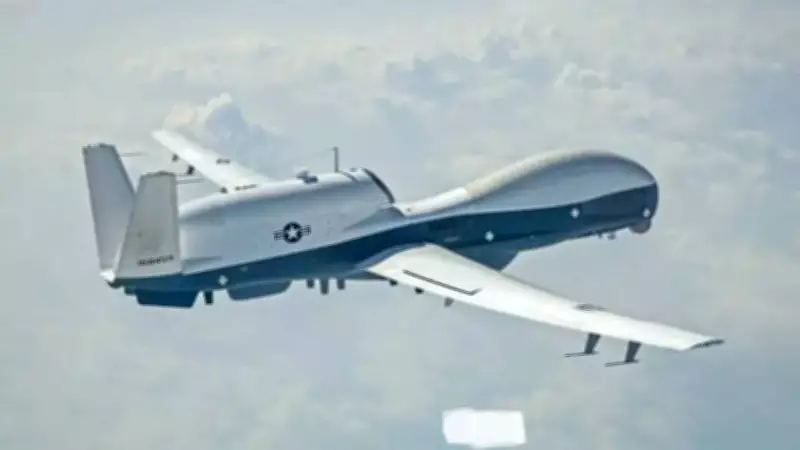
The MQ-4C Triton represents one of the most sophisticated and expensive unmanned surveillance platforms in the US Navy's arsenal. Developed by defense contractor Northrop Grumman under the Broad Area Maritime Surveillance program, this high-altitude, long-endurance drone is specifically engineered for persistent maritime intelligence, surveillance, and reconnaissance missions.
With operational capabilities exceeding 24 hours continuously at altitudes above 50,000 feet and a remarkable range of approximately 7,400 nautical miles, the Triton is ideally suited for monitoring critical maritime chokepoints like the Strait of Hormuz. The platform operates in coordination with other surveillance assets such as the Boeing P-8 Poseidon, serving as a high-altitude observation post that delivers real-time intelligence across vast oceanic regions.
Advanced Capabilities and Operational Role
The Triton is equipped with cutting-edge sensor systems, including an active electronically scanned array radar capable of monitoring extensive maritime zones while tracking vessels through analysis of their speed, location, and classification. Unlike earlier unmanned systems, the MQ-4C features reinforced structures, de-icing systems, and lightning protection that enable operations in harsh weather conditions, including descent through cloud layers for closer target observation.
Additional capabilities include:
- Electro-optical and infrared sensors for high-resolution imagery and live video feeds
- Electronic intelligence systems that detect and classify radar signals from ships and other platforms
- Semi-autonomous operation requiring minimal human intervention once mission parameters are established
- Communication relay functionality linking various battlefield assets to provide comprehensive operational awareness
Deployment and Strategic Importance
The MQ-4C Triton achieved initial operational capability with the US Navy in 2018 and has since been deployed across critical regions including the Indo-Pacific and the Middle East. The platform is considered central to US maritime surveillance strategy, particularly in sensitive areas like the Gulf region where it plays multiple crucial roles:
- Tracking naval activities and potential threats
- Supporting search and rescue operations
- Enhancing situational awareness for military planning and operations
- Providing persistent monitoring of strategic waterways
The disappearance of this advanced surveillance asset over one of the world's most geopolitically sensitive waterways raises significant questions about regional security dynamics and the potential implications for the recently negotiated US-Iran ceasefire agreement. As investigations continue, the incident underscores the complex interplay between advanced military technology and international diplomacy in volatile regions.