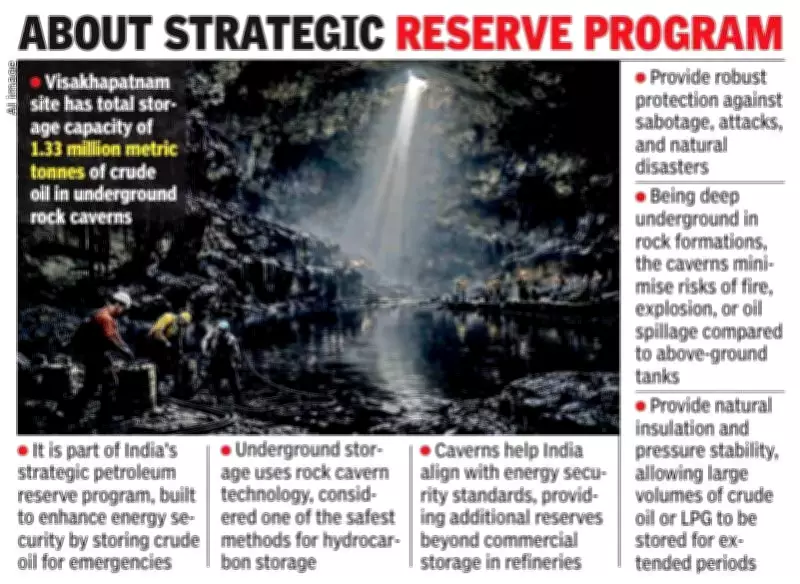
Visakhapatnam's Underground Oil Caverns Gain Strategic Importance Amid Middle East Conflict
Amid escalating tensions in the Middle East and significant disruptions to global oil supply routes through the critical Strait of Hormuz, India's underground crude oil storage facility in Visakhapatnam has emerged as a vital component of national energy security strategy. The facility, developed approximately a decade ago by Indian Strategic Petroleum Reserves Ltd (ISPRL), represents a sophisticated approach to safeguarding the nation's fuel supply during geopolitical crises.
Strategic Petroleum Reserve System Overview
The Visakhapatnam facility forms part of India's comprehensive strategic petroleum reserve (SPR) system, which includes additional caverns at Mangaluru and Padur. Collectively, these underground storage sites hold an impressive 5.33 million metric tonnes of crude oil, providing approximately 9-10 days of national consumption coverage. The Visakhapatnam location specifically contains 1.33 MMT of this total reserve capacity.
During periods of international conflict, geopolitical instability, or sudden supply shocks, these reserves serve as a crucial strategic buffer. They provide the government with valuable time to arrange alternative import arrangements, stabilize domestic fuel supply chains, and protect the broader economy from energy-related disruptions.

Visakhapatnam Facility Specifications
The Visakhapatnam storage complex is strategically positioned at the base of the Dolphin's Nose formation, which projects into the Bay of Bengal. The facility comprises two distinct underground caverns:
- Cavern A: With a substantial capacity of 1.03 million metric tonnes
- Cavern B: Providing an additional 0.30 million metric tonnes of storage
Security Advantages of Underground Storage
One of the most significant benefits of underground rock cavern storage is enhanced security. Being situated deep within rock formations provides natural protection against various threats:
- Natural Disaster Protection: The crude oil remains shielded from cyclones, storm surges, and other surface-level natural calamities
- Military Attack Resistance: The storage volume's enclosure within rock provides strong protection against sabotage attempts, including bombings, missile strikes, and drone attacks
- Operational Continuity: This security feature proves especially valuable for strategic reserves designed to remain functional during wartime or crisis conditions
Safety and Environmental Benefits
Beyond security considerations, underground caverns offer substantial safety advantages:
Reduced Hazard Potential: These facilities minimize risks associated with leaks and flammable vapor accumulation through sophisticated controlled ventilation systems, comprehensive monitoring protocols, and effective isolation mechanisms.
Fire Prevention: Compared to traditional surface storage options like pressurized spheres or refrigerated tanks, rock caverns significantly lower the probability of large-scale fires and mitigate the effects of external heat radiation.
Land Use Efficiency: Large storage volumes can be accommodated with minimal surface land requirements, which proves particularly advantageous in coastal industrial zones where land availability is limited and costs are substantial.
Construction and Operational Excellence
The construction of these underground facilities involves sophisticated engineering approaches:

- Drill-and-blast excavation techniques in competent rock formations
- Systematic structural support using rock bolts, shotcrete, and reinforced concrete where necessary
- Cavern geometry specifically designed for long-term stability based on extensive geotechnical investigations
- Advanced water curtain systems and grouting that maintain hydraulic barriers to prevent outward leakage
- Comprehensive instrumentation monitoring seepage, deformation, and pressure to ensure decades of safe operation
Economic and Strategic Implications
From an economic perspective, underground caverns typically demonstrate lower capital and operating costs compared to equivalent above-ground storage facilities. These savings result from reduced requirements for surface structures, piping systems, instrumentation, and land acquisition.
Operationally, the strategic petroleum reserve system enables controlled filling during favorable market conditions and strategic withdrawal during emergencies. This operational flexibility strengthens national energy security and enhances resilience against disruptions at critical maritime chokepoints like the Strait of Hormuz.
The Visakhapatnam facility helps India align with global energy security standards by providing additional reserves beyond commercial storage available at refineries. The underground storage technology represents one of the safest methods for hydrocarbon storage, offering robust protection against sabotage, attacks, and natural disasters while minimizing risks of fire, explosion, or oil spillage compared to above-ground alternatives.
As Middle East tensions continue to impact global energy markets, India's strategic petroleum reserves, particularly the Visakhapatnam facility, stand as critical infrastructure ensuring energy stability and national security during uncertain geopolitical periods.