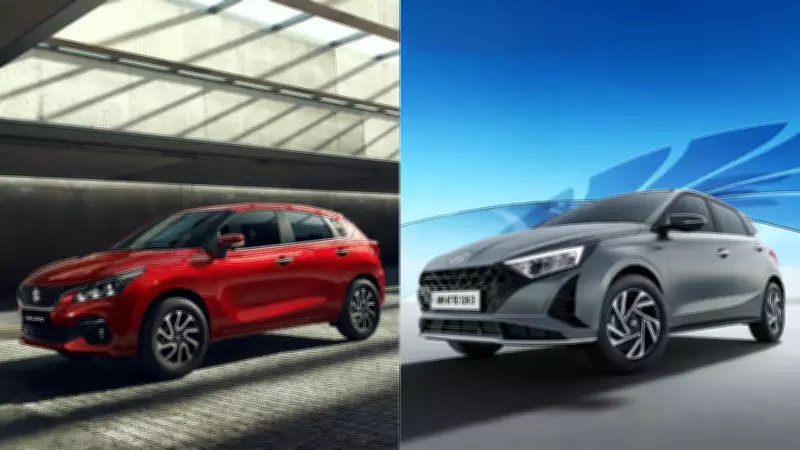
Hyundai i20 Gets Major Price Reduction, Reintroduces Entry-Level Variant
Hyundai Motor India has announced a significant price revision for select variants of its popular Hyundai i20 hatchback, making the premium model more accessible to a broader range of buyers. In a strategic move to boost competitiveness, the automaker has reintroduced the 'Era' variant, which slashes the entry price by approximately Rs 74,000. Additionally, price cuts have been applied to the mid-spec Magna Executive and Magna variants, further enhancing affordability.
Hyundai i20 vs Maruti Suzuki Baleno: Price and Variant Analysis
The Hyundai i20 is now offered in seven variants: Era, Magna Executive, Magna, Sportz, Sportz opt, Asta, and Asta opt. Prices range from Rs 5.99 lakh to Rs 10.45 lakh (ex-showroom). In comparison, the Maruti Suzuki Baleno comes in four variants: Sigma, Delta, Zeta, and Alpha, with prices spanning from Rs 5.99 lakh to Rs 9.10 lakh (ex-showroom). While both models start at the same entry price of Rs 5.99 lakh, the i20 extends to a higher top-end price, reflecting its premium positioning in the segment.
Dimension Comparison: i20 vs Baleno
When it comes to dimensions, the Hyundai i20 measures 3,995 mm in length, 1,775 mm in width, 1,505 mm in height, and has a wheelbase of 2,580 mm. It offers a boot space of 311 litres and a ground clearance of around 170 mm. The Maruti Suzuki Baleno, on the other hand, is 3,990 mm long, 1,745 mm wide, 1,500 mm tall, with a wheelbase of 2,520 mm. It provides a slightly larger boot at 318 litres and shares a similar ground clearance of 170 mm. Overall, the i20 is marginally longer, wider, and taller with a longer wheelbase, while the Baleno edges ahead in boot capacity.

Feature Showdown: Infotainment and Safety
The Hyundai i20 boasts a 10.25-inch touchscreen infotainment system with Apple CarPlay and Android Auto, a digital instrument cluster, a seven-speaker Bose sound system, wireless phone charging, a single-pane sunroof, automatic climate control, automatic headlamps, Type-C ports, cruise control, and connected car technology with over 60 features. Safety is robust with six airbags, ABS, EBD, ESC, hill assist control, three-point seatbelts for all seats, a reverse parking camera, and TPMS.
In contrast, the Maruti Baleno features a 9.0-inch Smartplay Pro+ touchscreen with Android Auto, Apple CarPlay, and Amazon Alexa support, a semi-digital cluster, voice commands, 'Suzuki Connect' tech, a heads-up display, a 360-degree camera, auto-dimming IRVM, automatic climate control, automatic LED headlights, and an Arkamys sound system. Safety includes six airbags, ABS with EBD, brake assist, ISOFIX anchors, ESC, and hill hold assist.
Powertrain and Performance Details
Both the Hyundai i20 and Maruti Baleno are offered with a single petrol engine option. The i20 is powered by a 1.2-litre, 4-cylinder NA VTVT petrol engine that delivers 83 hp of power and 115 Nm of torque, paired with either a 5-speed manual or a CVT automatic transmission.
The Baleno utilizes a 1.2-litre, 4-cylinder NA K-Series petrol engine producing 90 hp and 113 Nm of torque, available with a 5-speed manual or an AMT transmission. Notably, the Baleno also offers a CNG variant, providing an additional fuel option for cost-conscious buyers.
This price adjustment by Hyundai positions the i20 more competitively against rivals like the Tata Altroz, Maruti Suzuki Baleno, and Toyota Glanza, potentially attracting new customers in the hotly contested hatchback segment.