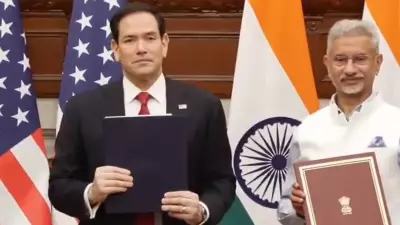
Trade negotiations between India and the United States are set to gain fresh momentum as senior officials from both nations commence a four-day meeting in New Delhi on Monday. The primary objective is to finalize the details of an interim trade agreement that has been under discussion for several months.
Key Negotiators and Focus Areas
The US delegation will be led by chief negotiator Brendan Lynch, while India will be represented by Darpan Jain, additional secretary in the department of commerce and the country's chief negotiator for these talks. According to the commerce ministry, the discussions are expected to concentrate on finalizing the interim agreement and advancing negotiations under the broader Bilateral Trade Agreement (BTA). Key areas under consideration include market access, non-tariff measures, customs and trade facilitation, investment promotion, and economic security alignment.
Background of the Interim Agreement
On February 7, India and the US issued a joint statement outlining the framework for the first phase of the BTA, also referred to as the interim trade agreement. The next step involves finalizing the legal text of the proposed deal. The framework reaffirmed both countries' commitment to continuing negotiations on the wider trade agreement.

As part of the agreed framework, the US had committed to lowering tariffs on India to 18% from 50%. It had also withdrawn the 25% tariffs imposed on Indian goods linked to purchases of Russian oil and planned to reduce the remaining 25% tariff to 18% under the pact.
Impact of US Tariff Changes
However, developments in the US tariff regime altered the situation. On February 20, the US Supreme Court ruled against President Donald Trump's reciprocal tariffs imposed under the 1977 International Emergency Economic Powers Act (IEEPA). Following the ruling, the US President announced a 10% tariff on all countries for a period of 150 days beginning February 24. These changes led to the postponement of a meeting between the chief negotiators that had originally been scheduled for February. The two sides later resumed discussions in Washington during a visit by the Indian delegation, led by Jain, from April 20 to 23, 2026.
The upcoming visit by the US team from June 1 to June 4 is intended to carry forward those discussions. With the tariff environment in the US having changed significantly since the framework was agreed, both countries may look at revisiting certain aspects of the agreement.
India's Proposals and Commitments
Under the framework, India had proposed eliminating or reducing tariffs on all US industrial goods as well as a broad range of American food and agricultural products. These include dried distillers' grains (DDGs), red sorghum used for animal feed, tree nuts, fresh and processed fruits, soybean oil, wine and spirits, among other products. India has also indicated its intention to purchase $500 billion worth of US energy products, aircraft and aircraft parts, precious metals, technology products, and coking coal over the next five years.
The talks are being viewed as significant because India currently enjoys a comparative advantage over competing countries. With all US trading partners now subject to a uniform 10% tariff, the framework may require recalibration.
Section 301 Investigations
Earlier in March, the Office of the US Trade Representative (USTR) initiated two unilateral Section 301 investigations involving several countries, including India. The probes relate to concerns over excess capacity and alleged failures to eliminate forced labour from global supply chains. India has rejected the allegations raised in the investigations and has requested that the probes be initiated, stating that the initiation notice does not provide a cogent rationale to support the claims.
Trade Data and Outlook
The US remained India's second-largest trading partner in 2025-26. India's exports to the US rose 0.92% to $87.3 billion during the fiscal year, while imports from the US increased 15.95% to $52.9 billion. India's trade surplus with the US stood at $34.4 billion in 2025-26, down from $40.89 billion in the previous fiscal year.