Nagpur: More than 25 years after the launch of the BrahMos supersonic cruise missile programme in India, Russia—which provided the know-how for making the weapon systems—is now keen to buy the Made in India weapon. The missiles are produced by BrahMos Aerospace Private Limited (BAPL), an Indo-Russian joint venture that also has a unit in Nagpur.
Although the system is based on Russian-origin technology, Moscow has so far relied on its own variants. It has now expressed interest in procuring the India-built BrahMos. Sources in the global defence business said that Russia may be needing the missiles probably to meet its war front needs.
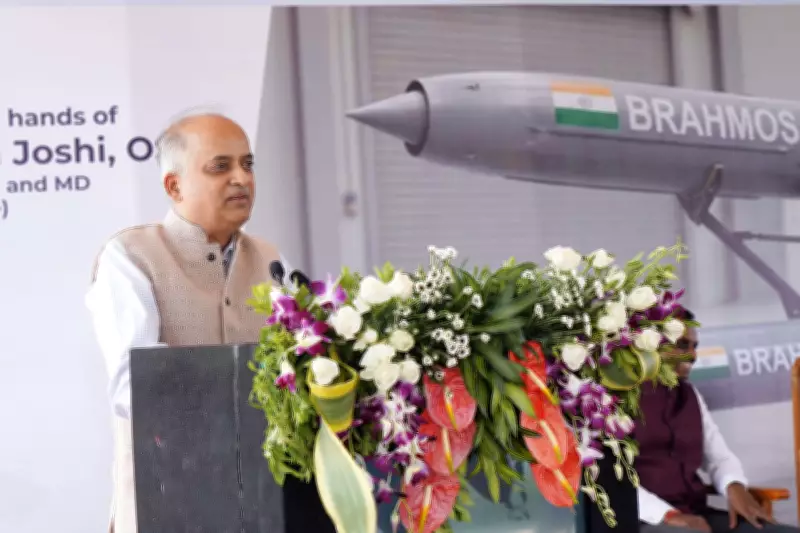
“Russians have their own manufacturing establishment in their country. India may partner to augment the facility if its capacity or work hand in hand with them to supply the BrahMos for their use,” said BAPL CEO and MD Jaiteerth R Joshi at Nagpur. The missile may also be made in BAPL units in India and sent to Russia, said a source.

India is also close to finalising a deal to export BrahMos missiles to Vietnam, pending minor clearances. Quotes have also been shared with several countries in both eastern and western regions. India already exports the missile system to the Philippines.
Joshi on Thursday flagged off the 100th booster for BrahMos missiles made at Nagpur’s Solar Defence and Aerospace Limited (SDAL) and the first-ever indigenous warhead of the missiles, also made by the company. Boosters are part of the rocket’s propulsion system, and warheads are the components that hit the target.
With the warhead ready for trials, BAPL expects to achieve nearly 85% indigenisation of the missile systems in the near future and also cut down the cost by 20% in one or two years, said Joshi. He said the Defence Research and Development Laboratory (DRDL) is also working on the Ramjet engine, apart from sleeker and more composite versions of BrahMos. A longer-range version of BrahMos is also in the pipeline. Work on developing the hypersonic versions, which need specialised material and redesigning, is also under way.
Addressing the flagging-off event at SDAL, Joshi also stressed increasing production for the missiles given the orders in hand. The BAPL chief said he expects SDAL to double its production of boosters to 12 per month. This translates into 12 missiles a month, he later told TOI on the sidelines. This is from the private sector alone, as the government has its own in-house facilities too.
Joshi said even as BAPL is looking for roping in more companies, so far SDAL is the lone private sector entity that is supplying missile boosters to it. The warhead would also be put to the test, and further production is expected to begin in due course. He also called for reducing the cost by the vendors.
Op Sindoor gave a live platform to test BrahMos’s mettle
Operation Sindoor gave a live platform for testing the BrahMos missiles. The conflict proved to the world that BrahMos is a robust system developed by India. Normally, the effectiveness of a weapon system is judged in controlled scenarios during trials. However, Operation Sindoor provided India a real war theatre. The missiles that were made some years ago were used during the conflict, he said.
Solar chief upbeat on warhead
SDAL chairman Satyanarayan Nuwal said delivering the 100th booster marks a major achievement for the company. He said the company is also ready to scale up the production of the boosters to meet the increased requirement in the coming days. The company acquired transfer of technology (ToT) from DRDO in 2018 and soon started work on it. Nuwal said he also hopes that the warhead made by the company would prove its lethality during the trials.