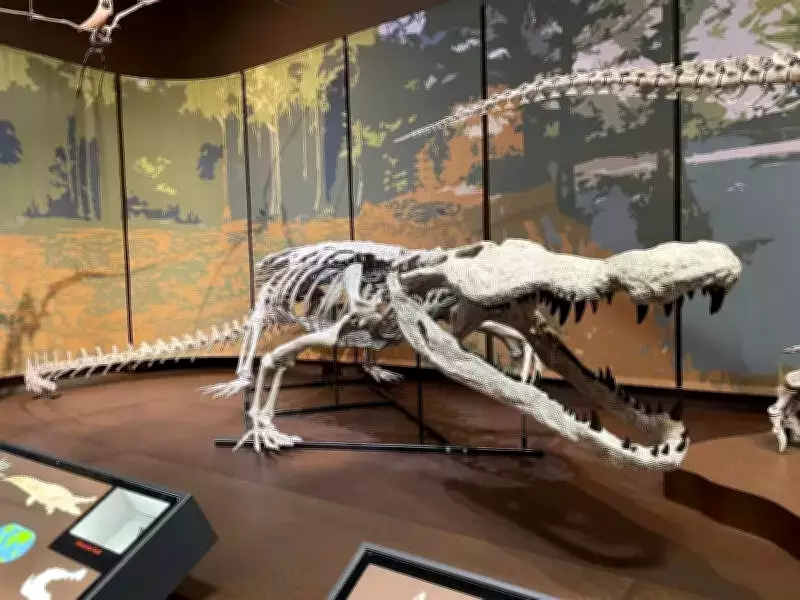
Museum Unveils Scientifically Accurate Giant Crocodilian Skeleton
A massive prehistoric crocodilian that once shared wetlands with dinosaurs has been resurrected in physical form through a groundbreaking museum installation. The Tellus Science Museum in Georgia has recently unveiled a life-sized mounted skeleton of Deinosuchus schwimmeri, marking the culmination of decades of meticulous scientific investigation and technical craftsmanship.
First Replica Based on Fossil Evidence Rather Than Artistic License
This remarkable replica represents the first instance where such a reconstruction has been built with primary attention to fossil evidence instead of artistic interpretation. The project draws extensively on over forty years of dedicated research by paleontologist Dr. David Schwimmer, whose pioneering work has fundamentally reshaped our understanding of this formidable predator and its ecological role during the Late Cretaceous period.
The display provides visitors with an unprecedented opportunity to appreciate the true scale, anatomical details, and environmental context of this ancient creature, all grounded in rigorous scholarship rather than sensational spectacle.

The Formidable Deinosuchus: A Top Cretaceous Predator
Deinosuchus schwimmeri thrived approximately 83 to 76 million years ago, when extensive coastal plains and shallow seas covered much of eastern North America. Closely related to modern alligators, this colossal reptile grew to lengths approaching 30 feet and weighed several tons, placing it firmly at the apex of its food chain.
Fossil evidence strongly indicates that it preyed upon large animals, including dinosaurs that ventured too close to water sources. Bite marks preserved on dinosaur bones confirm that Deinosuchus was not merely a scavenger but an active and formidable hunter within its ecosystem.
Four Decades of Research Behind the Reconstruction
While the physical mounting of the skeleton required more than two years of technical work, the scientific foundation stretches back over forty years. Dr. Schwimmer began systematically collecting Deinosuchus fossils in the late 1970s, focusing his efforts on key sites across Georgia, Alabama, and Texas.
Many of these significant fossils are now housed in prestigious institutions, including the Smithsonian Institution and the American Museum of Natural History. Fieldwork was substantially supported by grants from National Geographic. As the fossil record expanded, researchers gradually moved beyond isolated fragments to confidently reconstruct the animal's complete form.
Recognition of a Distinct Species
For many years, Deinosuchus fossils discovered across North America were classified under a single, widespread species. This classification was revised in 2020 when a team of paleontologists formally recognized Deinosuchus schwimmeri as a distinct eastern species, honoring Dr. Schwimmer's lifelong contributions to the field.
This critical research clarified morphological differences between eastern and western fossil specimens, resolving long-standing taxonomic confusion. The new museum replica specifically reflects the anatomical characteristics attributed to D. schwimmeri, based on this refined understanding.
Precision Engineering of a Museum-Scale Skeleton
Creating the accurate replica involved close collaboration between Dr. Schwimmer and Triebold Paleontology, a company specializing in scientific fossil models. The team employed high-resolution 3D scans of original fossils to meticulously reconstruct both the skeleton and the heavy osteoderm armor that protected the animal's body.
This advanced process allowed missing skeletal elements to be intelligently inferred from related specimens while strictly adhering to known anatomical constraints. The final result intentionally avoids dramatization, striving instead to represent the animal as accurately as current evidence permits. Subtle details in proportion and joint articulation reflect plausible postures and movement patterns.

A Patient Reconstruction from the Ground Up
The replica does not claim to answer every remaining question about Deinosuchus. Knowledge gaps persist, and future fossil discoveries may alter current interpretations. What it offers is a methodical and evidence-based reconstruction, patiently built from data collected over multiple decades.
Under museum lighting, the animal stands not as a mythical monster, but as a tangible product of its ancient world—a creature shaped by its aquatic habitat, available prey, and the passage of deep time.