Dyal Singh College in Karnal, established on September 16, 1949, two years after the Partition, continues the legacy of Sardar Dyal Singh Majithia, a renowned philanthropist and educationist. The college was founded as the successor to the original Dyal Singh College in Lahore, which was established in 1910 and is now known as Government Dyal Singh College in Pakistan.
Post-Partition Founding
After the Partition of India in 1947, the properties of the Dyal Singh College Trust remained in Lahore. However, educationists in India were determined to uphold Sardar Majithia’s educational ideals. They acquired “Umar Manzil,” an evacuee property in Karnal with a large open area, which was considered ideal for the college. The property originally belonged to a Muslim Nawab of Karnal, who used to hold public courts there to hear local grievances.
“After the Partition, it was feared that the noble legacy of Sardar Majithia would no longer be able to enrich the coming generation with the best of academic, cultural and national ideals. The then honorary secretary of the Trust Society and Vice-Chancellor of Panjab University, Dewan Anand Kumar, took the initiative and founded the college with the support of the then Assistant Secretary, L Sewa Ram,” said Dr Ashima Gakhar, Principal of Dyal Singh College, Karnal.

Preserved Heritage Building
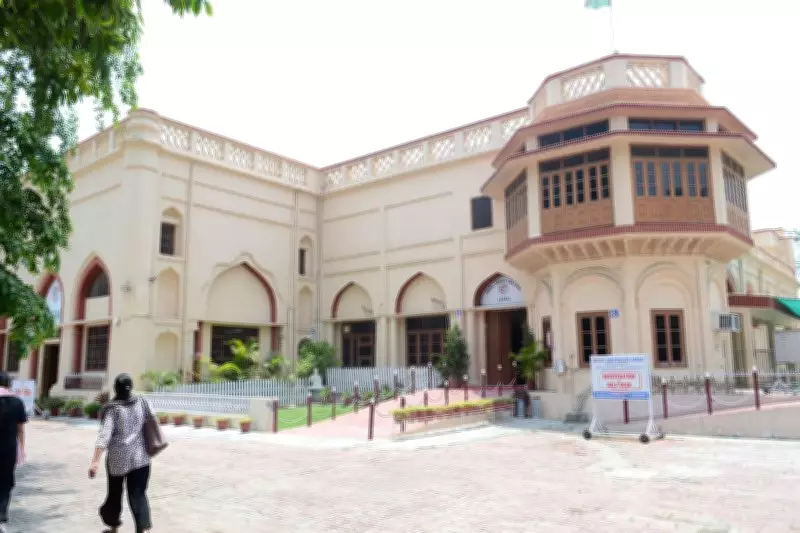
The original structure of the building has been carefully preserved by the college authorities. The present administrative block, library, geography department, girls’ common room, and staff room are all part of this historic building. Its thick walls, high ceilings, and artistic inscriptions reflect the architectural beauty of a bygone era and serve as a reminder of the institution’s rich heritage.
“Although the building has not been declared a heritage structure, every effort has been made to preserve its original architecture, texture and cultural significance,” Dr Gakhar added.
Library and Academic Growth
The college library houses around 50,000 books, including many rare and valuable volumes. This library was inspired by Sardar Majithia’s vision, who dedicated one of his prime properties in Lahore for the establishment of a public library, which continues to function today as the Dyal Singh Public Library in Lahore.
As per former Principal Dr Ramji Lal, after the Partition, Karnal lacked higher educational facilities. The establishment of Dyal Singh College was a collective effort, with special credit going to educationist Diwan Anand Kumar, who played a major role in promoting higher education in northern India. “Over the years, trustees, principals and faculty members have made efforts to preserve the building’s original character,” he added.
The first academic session of the college started on September 19, 1949, and was inaugurated by the then Deputy Commissioner L Fletcher, who later served as Vice-Chancellor of Kurukshetra University and Haryana Agricultural University. Rai Sahib Lala Raghunath Sahai became the founding Principal, according to Dr Lal.
Prof Kushal Pal, former head of the department of political science, who served the college for around three decades, noted that the history of Dyal Singh College is closely linked to the vision of Sardar Majithia, whose commitment to education, secular values, and public welfare continues to inspire generations.
Current Status and Accreditation
Initially, the college offered only Arts courses with 180 students and eight faculty members. Over the years, science and commerce streams were introduced, and an evening college was started but later discontinued. The college is now affiliated with Kurukshetra University and offers nine undergraduate courses across 21 departments, six postgraduate courses, and PhD programmes. Almost 100 faculty members teach students across various disciplines, and more than 50 non-teaching staff members serve the institute.

The college has honed the skills of thousands of young men and women who have excelled in diverse fields. It has a well-established registered alumni association. Dyal Singh College has become one of the leading postgraduate institutions in the region. The college received ‘A+’ Grade accreditation from the National Assessment and Accreditation Council (NAAC) in 2004 and currently holds an A+ Grade. It is known for providing quality higher education and for helping students secure placements in multinational companies.
“Strengthening the dedication of those who built this institution and paving the way for future learners, our college stands as a remarkable symbol of educational excellence and cultural heritage,” Dr Gakhar added.