The landscape of school education in India is witnessing a significant and simultaneous shift in 2025. Rather than a single dramatic change, a series of long-planned reforms have converged, altering classroom structures, examination patterns, and administrative frameworks across the country. This year marks a pivotal point where cumulative changes in structure, technology, and administration are becoming a tangible reality for students, teachers, and parents nationwide.
A New Foundation: The 5+3+3+4 Structure Replaces 10+2
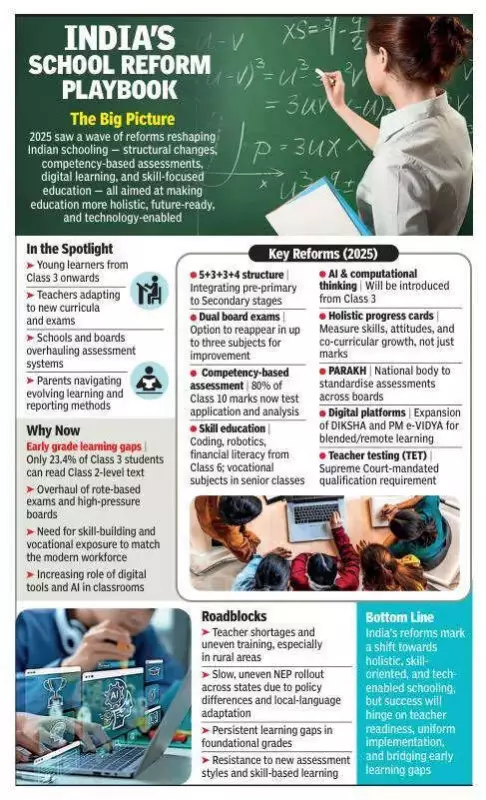
Fifty years after Maharashtra pioneered the 10+2 system following the Kothari Commission, Indian education is undergoing another major structural reset. By September 2025, most CBSE, state, and private schools began transitioning to the 5+3+3+4 stage structure. This model reorganises schooling into four clear phases: Foundational (ages 3–8), Preparatory (8–11), Middle (11–14), and Secondary (14–18).
"The transition has been quite smooth. This classification is actually better because it includes pre-primary education into the formal educational setup, allowing us to build the foundational stage from nursery to the second standard together for the first time," observed Hari Vishwanath, principal of Delhi Public School (DPS), Nerul. This shift formally retires the long-standing 10+2 framework that has defined Indian schooling for decades.

Examinations and Pedagogy: Moving Beyond Rote Learning
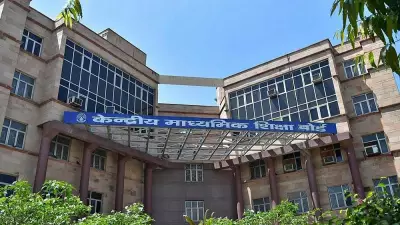
In a bid to reduce academic pressure, the CBSE announced in July 2025 that Class 10 students would be allowed to appear for two board examinations to improve scores in up to three subjects. While the first exam is mandatory, students can opt for a second attempt. The board stated this aims to "reduce the high-stakes nature of board examinations and the coaching culture."
However, educators have raised practical concerns. With only a two-month gap between exams, some question the potential for meaningful improvement. "It's old wine in a new bottle," remarked a CBSE school principal from Madhya Pradesh, noting that the 'compartment' tag has simply been removed. Meanwhile, a parallel revolution is occurring inside classrooms. The CBSE has revised its examination pattern so that up to 80% of the Class 10 board paper will now be competency-driven, focusing on analysis and application over factual recall.
"Questions from the end of every chapter have disappeared in the textbooks. Now we have to emphasise the concepts and work on the understanding a child develops," explained Latha Janardhan, head teacher of the Anthony D'Souza School in Mumbai's Byculla area.
Bridging School and the Future: Skills, Teachers, and Tech
A major thrust in 2025 is the integration of vocational and skill-based education. CBSE schools now mandate exposure from Class 6, with a sharper focus on employability in senior classes. Union Education Minister Dharmendra Pradhan announced at IIT Madras that skill-based subjects would be introduced at the Class 11 and 12 levels.
"We have introduced learning modules in areas such as communication, coding, robotics, and financial literacy," said Sonal Mittal, principal of EuroSchool, Bengaluru. This shift responds to employer demands for adaptable graduates with transferable skills.
Teacher qualifications have also come under scrutiny. A Supreme Court ruling on September 1, 2025, declared the Teacher Eligibility Test (TET) a constitutional requirement. The verdict gives an estimated 20–30 lakh public-sector teachers a two-year deadline to clear the TET with at least 60% marks by September 2027, or face potential termination.
The decision has sparked protests, with teacher groups calling it unfair. Madhav Suryavanshi of the Shikshan Vikas Manch highlighted the TET's historically low pass rate of 3–4%, warning of widespread job losses in an already strained system.

Additional Reforms and Persistent Challenges
Other key changes in 2025 include introducing artificial intelligence and computational thinking from Class 3, the rollout of holistic progress cards, and the establishment of PARAKH, a national body for standardising assessments. Digital platforms like DIKSHA continue to expand to support blended learning.
Despite this wave of reform, deep-rooted challenges persist. A report by NGO Pratham found that only 23.4% of Class 3 students in government schools could read a Class 2-level text. Shortages of qualified teachers, especially in rural areas, and uneven implementation of the National Education Policy across states due to regional adaptations and resistance continue to slow the pace of change.
The year 2025, therefore, stands as a landmark of ambitious transition for Indian school education, where the alignment of multiple policy threads is finally being tested on the ground, with its ultimate success hinging on effective execution and addressing systemic gaps.