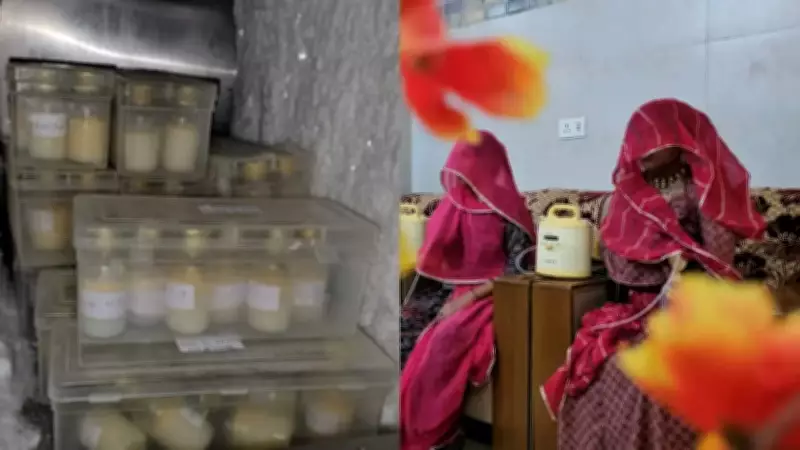
In a heartwarming act of humanity, the Mother Milk Bank at Barmer District Hospital has become a lifeline for newborn babies who cannot receive milk from their own mothers. Since its establishment on March 4, 2018, the bank has collected donations from 3,523 women, who have been aptly called 'Yashoda Mothers' after the foster mother of Lord Krishna. These donations have resulted in 29,882 units of breast milk, which have helped save the lives of 3,165 newborns.
A Symbol of Compassion
The word 'mother' is synonymous with unconditional love and sacrifice. In Barmer, women have extended that care beyond their own children to babies they have never met. The milk bank has emerged as a remarkable example of compassion and humanity, providing hope to thousands of families. Dr. Hanuman Ram Choudhary, Superintendent of Barmer District Hospital, said, 'Every mother gives life to her child, but the women of Barmer have shown that motherhood goes beyond relationships. A mother's milk can become hope for another family as well.'
How the Milk Bank Works
According to hospital officials, no donated milk is used directly. Every sample undergoes proper screening and testing before storage. After HIV and infection screening, the milk is processed and preserved through a secure procedure at minus 19 degrees Celsius. The milk can be safely preserved for up to six months.

ANM Manju Bhati from the Mother Milk Bank said that 220 units (equivalent to 6,600 ml) are currently in storage. She added that nearly 1,000 units were sent to Ajmer in 2018, while 12,220 units have been used for community needs. The donations from 3,523 mothers have resulted in the collection of 29,882 units of breast milk so far.
Impact and Reach
The initiative has not only saved lives but also inspired other regions. The milk bank's success highlights the power of community support and the selflessness of mothers. It serves as a model for other districts to follow, demonstrating that collective efforts can make a significant difference in infant healthcare.