Chennai: A landmark study published in the peer-reviewed US journal Critical Care Medicine has revealed that women admitted to intensive care units (ICU) across India receive significantly less aggressive interventions than men, including life support from ventilators, dialysis, and cardiovascular drugs. Despite this, their rate of survival is nearly identical to that of men. The findings have left intensive care specialists questioning whether women are being under-treated or men over-treated.
Study Details and Key Findings
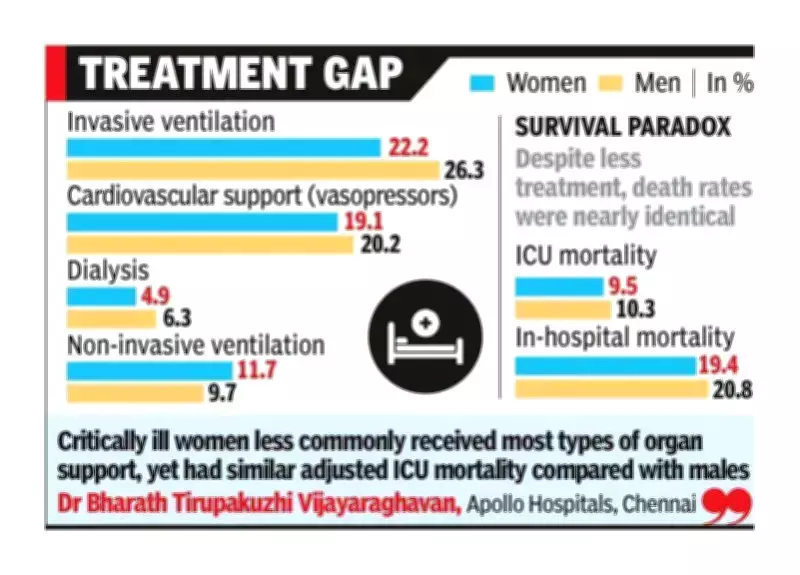
The research analyzed data from more than 82,000 patients across 45 ICUs in 26 hospitals, both public and private, over nearly six years. The results indicate that women were 22% less likely than men to receive invasive mechanical ventilation, a critical intervention for most critically ill patients, and 27% less likely to receive kidney replacement therapy. They were also less likely to be given vasopressors, which are drugs used to stabilize dangerously low blood pressure. However, women were more likely to receive non-invasive ventilation, a gentler form of breathing support.
Dr. Bharath Kumar Tirupakuzhi Vijayaraghavan, lead author of the study and critical care specialist at Apollo Hospitals, Chennai, commented, "We don't yet know if it's good or bad." Despite receiving fewer critical interventions, women died in the ICU at a rate of 9.5%, barely different from the 10.3% recorded for men.

Potential Explanations for the Disparity
Researchers suggest that doctors may be misjudging how ill women are, either underestimating severity in women or overestimating it in men. Additionally, family members, influenced by deeply entrenched social norms, may make treatment decisions for women that they would not make for men. Dr. Sristi Sharma, co-author of the study, stated, "In a country where women routinely face barriers to healthcare access, those biases do not simply disappear at the ICU door."
Dr. Vijayaraghavan also noted, "In critical care, more is not always better. Putting a patient on an invasive ventilator carries risks—lung injury, infections, complications. If such support doesn't precisely match what a patient's body needs, it can do more harm than good."
Need for Further Research
The authors agree that more study is needed to determine whether women are under-treated or men over-treated. Dr. Vijayaraghavan added, "We also need to ask whether women and men have equal access to preventive and early care." The study predominantly covered patients in private facilities in large urban centers, leaving the picture in rural hospitals—where gender discrimination in healthcare is often starker—largely unmapped.