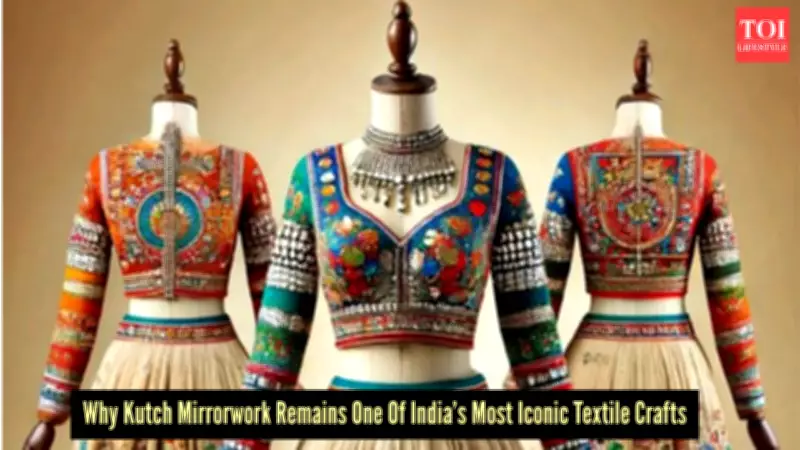
The Allure of Mirror Work
Have you ever twirled in a heavy, mirror-studded chaniya choli during Navratri and wondered who actually made it? Or why the fabric carries so much weight? That dazzling reflection catching the festive lights is not just a random fashion statement. It is a centuries-old survival story, a tribal passport, and a piece of wearable magic from the arid landscapes of Kutch. Locals call it Abhala Bharat, or Shisha embroidery. Its history is far more fascinating than you might think.
A Journey Across Borders
You would likely assume this craft originated in the heart of Gujarat. Surprisingly, it did not. The concept traces its roots back to 13th-century Persia. It traveled across borders with roaming travelers and traders, eventually catching the eye of Mughal emperors who loved integrating the technique into their royal textiles.
By the 17th century, nomadic pastoral groups like the Jats trekked from places such as Balochistan and settled in the Kutch region. They brought their needles, threads, and heritage with them. Early artisans did not even use glass. They worked with whatever they could scavenge: shiny beetle wings, naturally occurring mica, old coins, and polished metal. Today, they rely heavily on machine-cut glass, but the handmade essence remains the same.

The Tribal Alphabet
Kutchi embroidery is not just decorative; it is a visual code. To the trained eye, a woman's embroidered skirt reveals her identity, clan history, and community way of life. The Ahir community, historically settled farmers, produces bold work called thassa, bursting with agricultural life: huge curvilinear flowers, peacocks, and vibrant reds, greens, and yellows. The Rabaris, as desert nomads, record migration routes through their style. They use heavy stitches and massive mirrors designed to catch harsh desert light. Their motifs often feature scorpions stitched as protective charms against dark, moody backgrounds.
Jat women create insanely geometric work using a counted thread technique without drawn outlines. The result resembles Islamic mosaic tilework, with mirrors anchored at the center of sharp cross-stitches. The Neran style uses tiny, intricate eye-shaped stitches to create a lace-like illusion. The Node community focuses on dense, 3D embossed effects using large circular motifs.
Caged Glass: The Magic of Tension
How do you sew a flat piece of glass onto cloth? Glass has no holes. The secret is pure tension. True artisans weave an intricate cage of thread over the edges of the mirror to lock it flat against the fabric. Sometimes they use a Star Stitch that crosses directly over the glass, or a tight triangular frame that grips the lip of the mirror. Once the glass is locked down, they decorate the surrounding fabric with regional stitches like the tight chain stitch (Saankdi), herringbone (Vaano), or shadow backstitch (Bakhiyo).
Warding Off the Evil Eye
Traditionally, these masterpieces were deeply personal. A woman would spend years embroidering veils (odhnis) and doorway hangings (torans) for her dowry. The mirrors served a higher purpose: desert communities believed reflective surfaces would deflect the evil eye and trap bad spirits before they could harm the wearer.
Today, this ancient craft is a massive global trend, spotted in high-end couture and fast-fashion racks. But there is a catch. Authentic Shisha is under serious threat from cheap, factory-made knockoffs that simply glue mirrors on. So, the next time you pick up a piece of mirror work, take a closer look. Run your fingers over the threads. If the mirror is carefully caged by a web of hand-stitched thread, you are holding not just a garment but a beautifully preserved piece of history.