Understanding Salt's Character and Function
When discussing the essentials of an Indian kitchen, items like a gas stove, utensils, grains, spices, salt, and sugar are non-negotiable. Extra care is required for their storage, especially for salt, which is highly sensitive to moisture during humid months. Do you know why salt should not be stored in stainless steel and how to store it correctly during hot and humid weather? Read on to find out.
Why Salt Reacts to Humidity
According to science, salt is naturally hygroscopic, meaning it absorbs moisture from the surrounding air. During humid summer months and monsoons, the air contains high amounts of water vapor. When salt is exposed to this environment, it pulls in moisture, becoming damp, sticky, or forming hard lumps that make it difficult to use in dishes. Although this does not make the salt unsafe to eat, it affects its texture, making it hard to sprinkle or measure accurately. In extreme cases, it can develop a slightly off consistency that impacts how it dissolves in food.
What Happens When You Store Salt in a Steel Container
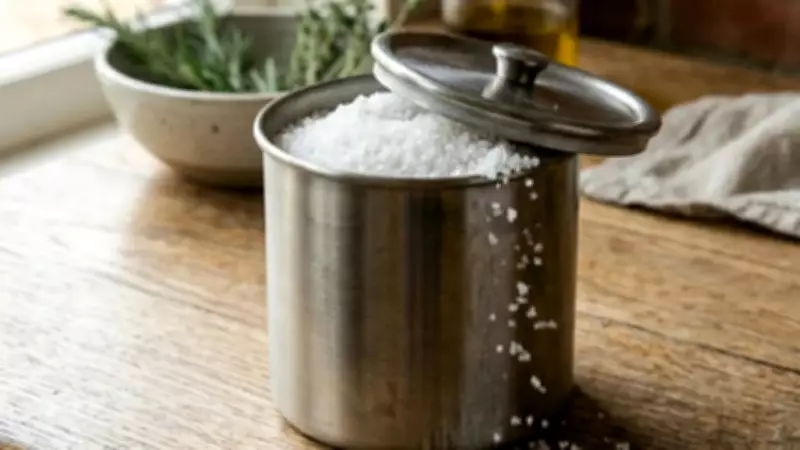
In Indian kitchens, stainless steel containers are a common choice because they are sturdy, long-lasting, and non-reactive. However, when it comes to storing salt, it is a wrong choice. While salt does not chemically react with high-quality stainless steel, the issue lies in moisture control. Many traditional steel containers are not completely airtight, and during humid weather, moisture from the air can seep into the container, especially when opened frequently. This leads to condensation forming inside, which is then absorbed by the salt, causing it to become lumpy and difficult to use. That is why it is recommended not to store salt in steel containers.

Signs That Your Salt Is Affected by Moisture
- Formation of hard clumps or chunks
- Salt sticking to spoons or fingers
- Difficulty in pouring or sprinkling evenly
4 Right Ways to Store Salt During Humid Months
Use an Airtight Container
According to home chefs, the most effective way to keep salt dry is to store it in a tightly sealed container. The best options are glass jars or high-quality plastic containers with secure lids. Airtight storage prevents moisture from entering and keeps the salt free-flowing.
Add a Natural Moisture Absorber
If your salt tends to get wet during humid weather, a simple kitchen trick is to place a few grains of uncooked rice or a small piece of muslin cloth filled with rice inside the salt container. This helps absorb excess moisture, preventing clumping. Alternatively, food-safe silica gel packs can be used for the same purpose.
Store in a Cool, Dry Place
Ensure that your salt container is kept away from heat and humidity sources like the stove, sink, or dishwasher. According to experts, a closed cabinet in a dry part of the kitchen is ideal for storing salt. Avoid leaving it open for long periods, especially during rainy or humid weather.
Use a Dry Spoon
When using salt, always use a high-quality dry plastic or wooden spoon to add salt to your food. This prevents introducing moisture into the container.
Images Courtesy: istock