North Kolkata's Early Role in Yoga's Global Journey
Long before fitness became a billion-dollar industry, north Kolkata had already begun laying its foundations in the early twentieth century. From ashramas to byayam samities and kushti akharas, generations explored ways not only to strengthen the body but also to discipline the mind. From this unique milieu of physical culture and spiritual inquiry emerged Paramahansa Yogananda, who revived, popularised and carried the forgotten traditions of Kriya Yoga across oceans, becoming one of the most influential ambassadors of Indian spirituality. Today, as yoga is practised by millions worldwide, Kolkata's role in that journey remains largely overlooked. This International Day of Yoga, we revisit where it all began, tracing yoga's evolution through the narrow lanes of old Kolkata and uncovering the people, institutions and ideas that helped shape a global movement.
From North Kolkata to a Global Mission
When Yogananda was a student at Scottish Church College, he began visiting Nagendranath Bhaduri (Bhaduri Mahashay) at what is now known as Nagendra Math, an association that influenced his formative years. According to Swami Achyutananda Giri, he later inherited a Kriya Yoga lineage tracing from Mahavatar Babaji to Lahiri Mahasaya through Sri Yukteswar, but his destiny extended beyond spiritual practice. Though drawn to a contemplative life, he was guided towards a larger mission of globalising India's spiritual wisdom. That mission took him to the US in 1920, carrying practical techniques for meditation and self-realisation. “I personally feel the relationship between Bhaduri Mahashay and Yogananda ji was that of a spiritual father and son. Bhaduri Mahashay understood that the task of spreading yoga globally was specifically destined for Yogananda ji,” says Dr Subhadip Bandyopadhyay, a descendant of Bhaduri Mahashay from his mother’s side.
Bishnu Charan Ghosh and Yoga as Physical Culture
While Yogananda carried the legacy of Kriya Yoga, his brother and first disciple, Bishnu Charan Ghosh, shaped another important strand of Kolkata’s yoga heritage through physical education. At Ghosh’s College of Physical Education and Yoga, he developed a system that blended classical yogic knowledge with modern approaches to fitness. Today, it is led by Ghosh’s granddaughter, Muktamala Mitra, who serves as the principal of the college while adapting the practices to contemporary needs. The college teaches traditional asanas and pranayama rooted in texts such as the Hatha Yoga Pradipika and The Yoga Sutras Of Patanjali, while placing emphasis on yoga therapy and personalised instruction. With around 18–19 teachers and over 150 students, it reflects yoga’s evolution to holistic well-being. “People today are far more health conscious. That awareness has brought many back to yoga,” says Muktamala.

The Globalisation of Kriya Yoga
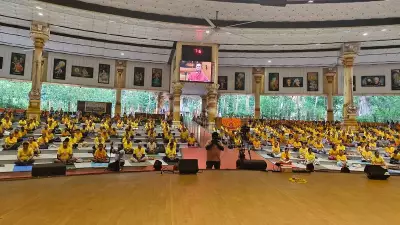
More than a century after Paramahansa Yogananda sailed to the US in 1920, his influence continues to shape how millions understand yoga. According to Swami Achyutananda Giri, head of the Yogoda Satsanga Society (YSS) headquarters in Dakshineswar, Kriya Yoga offers a more expansive understanding of the practice, positioning it within the broader framework of Raja Yoga and emphasising the cultivation of energy, consciousness and self-realisation. He describes it as a scientific method of inner development, one that works systematically with the mind, breath and life-force to elevate human consciousness. Through Yogananda’s teachings, meditation and pranayama became pathways not merely to physical well-being but to deeper spiritual awareness. His influence continues through the YSS and its global network of centres, popularly known as the Self-Realization Fellowship (SRF). For Swami Achyutananda, the continued appeal of Yogananda’s teachings lies in their ability to bridge ancient spiritual wisdom with a modern, scientific temperament.

A Cultural Ecosystem
Yoga researcher, author and teacher Ida Jo points to a unique ecosystem where clubs, akharas, spiritual institutions, literature and reform movements converged to shape modern yoga, while also highlighting overlooked contributors such as Reba Rakshit and Mohila Yogbayam Kendra. Within Yogananda’s own family, that legacy remains personal. “While Hatha Yoga prepares the body, Kriya Yoga is a science of inner transformation, using the body as a vehicle for spiritual growth and self-realisation,” says his great-grandniece, Kavya Dutta.
Legacy of the Byayam Samities
Long before yoga studios became commonplace, north Kolkata’s byayam samities served as hubs for physical culture. Institutions such as Simla, Bagbazar and Bowbazar Byayam Samity nurtured generations through football, gymnastics, wrestling and yoga. As physical culture evolved, wrestling pits gave way to gymnasiums and traditional strength training was supplemented by modern equipment. Yet the core philosophy remained unchanged. “The objective is still discipline, fitness and character-building; only the methods have become more scientific,” says Simla Byayam Samity secretary Achinta Das. Instructor Somnath Kundu sees yoga as a natural continuation of that legacy, keeping these institutions relevant across generations.
Did You Know
Paramahansa Yogananda started the Saraswat Library at the Garpar Road residence of his friend Tulsi Bose, with just two students, laying the foundations of what would later become the Yogoda Satsanga Society (YSS) of India.