Ancient Neolithic Landscape Revealed Beneath Modern Czech Farmland
History often resides in unexpected places, not confined to museums or textbooks but sometimes lying silently beneath our feet. Imagine walking across an ordinary agricultural field, unaware that you are traversing 5,000-year-old graves, ancient dwellings, or ritual boundaries. This scenario, reminiscent of a fiction film, has become reality with a groundbreaking discovery in Bohemia, where a seemingly modern landscape conceals a hidden Neolithic world of long barrows and settlements.
A Flat Field That Holds Ancient Secrets
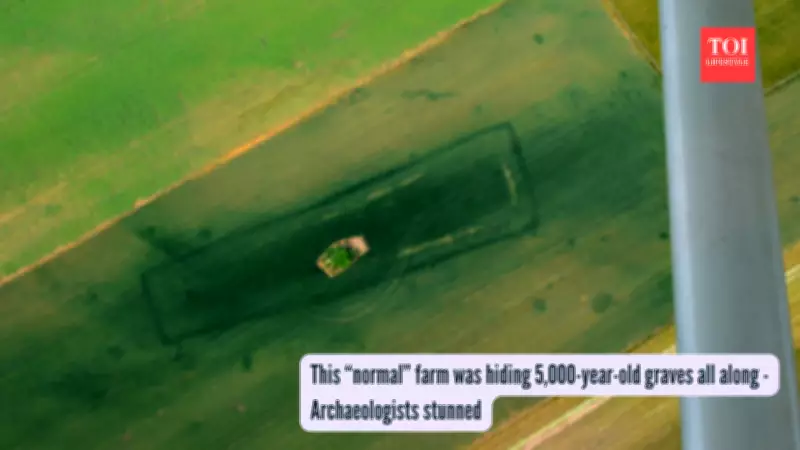
In northwestern Bohemia, Czech Republic, what appears as an "empty" flat field has been revealed to be anything but barren. Archaeologists have employed advanced remote-sensing tools to uncover a rich prehistoric cemetery and clustered settlement traces, all buried under active farmland. This discovery challenges previous assumptions about the erasure of ancient history by agricultural activities.
The research, led by a collaborative Czech team from the University of West Bohemia, Masaryk University, and Charles University, demonstrates that Neolithic long barrows—elongated burial mounds dating back approximately 5,000 years—can still be detected even after centuries of farming have smoothed them nearly flat. This finding compels experts to reconsider how much early funerary and village life might persist in fields once thought to have obliterated the past.

Detailed Findings from the Field Study
In the study area of northwestern Bohemia, researchers identified an astonishing 2,918 archaeological features. These include traces of ditches, pits, enclosures, and potential building remains, organized into four main clusters. One cluster stands out as a probable settlement, while the others are funerary zones located about 500 to 1,000 meters away. This spatial gap was not accidental; it aligns with the concept that Neolithic communities maintained a symbolic distance between the living and the dead, reflecting deep cultural practices.
Notable Discoveries: The Neolithic Long Barrows
Among the most significant finds are the Neolithic long barrows, constructed around 3000 BCE. These long, low mounds represent some of the earliest large-scale tomb monuments in Central Europe. Today, many of these barrows are barely visible to the naked eye, but their shapes become clear when archaeologists layer different types of remote-sensing data. The study focused particularly on two barrows near Mount Říp—Dušníky 1 and Nížebohy—whose outlines only emerge through the combined analysis of aerial cropmarks, magnetic signals, and subtle surface changes.
Innovative Methods for Uncovering the Past
The team utilized a blend of traditional aerial work and high-tech scanning techniques. Oblique aerial photography, taken at an angle, reveals cropmarks—patterns in plant growth that trace buried features like ditches, pits, or walls. These patterns occur because such features alter soil properties, affecting water and nutrient retention. Additionally, earlier regional work involved over 1,085 soil samples and chemical analysis, showing that signs of everyday settlement activity clustered in specific areas but not around the barrows, a pattern corroborated by magnetometry.
Symbolic Separation Between Living and Dead
Once the settlement traces are visualized, their arrangement tells a compelling story. The burial mounds are positioned far enough away that the journey to them would have felt intentional, akin to a pilgrimage to a sacred place rather than a casual stroll. This supports the theory that long barrows were deliberately constructed at the margins of settlement zones, creating a buffer between the living and the dead. Researchers argue that this separation was maintained and renegotiated over extended periods, indicating deep-seated cultural norms governing the placement of activities.

Broader Implications Beyond Bohemia
Published in Archaeological Prospection, this study extends beyond merely locating old graves. It demonstrates that entire prehistoric settlement systems—including homes, boundaries, and ritual areas—can be reconstructed even when surface evidence appears erased by farming or infrastructure. The revelation of thousands of archaeological features across modern fields suggests that Neolithic activity was denser and more structured than previously assumed in older surveys, offering new insights into ancient human organization and cultural practices.