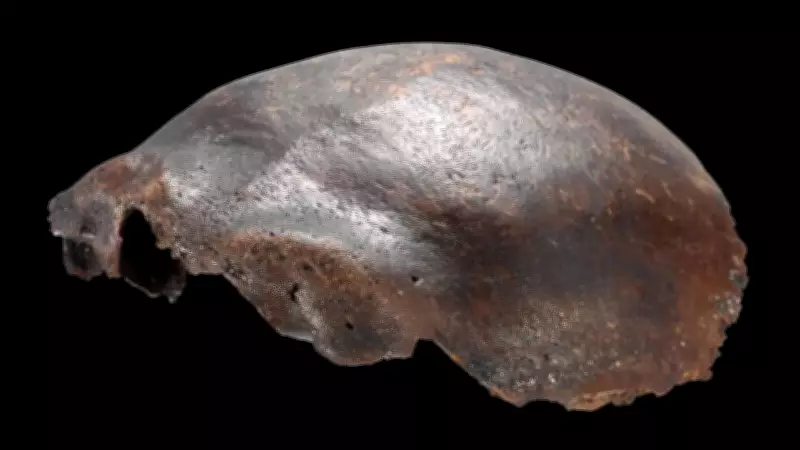
Ancient Skull Fragment Debunked: Once Thought a Neanderthal Hybrid, Now Just Modern Human
In 1973, during archaeological excavations in Hahnöfersand, Germany, a partial human skull fragment was unearthed, sparking decades of scientific intrigue and debate. This discovery, made without any accompanying cultural artifacts or tools, presented a challenging puzzle for researchers from the outset. The bone, identified as a frontal bone from the upper forehead region, initially appeared unusual due to its shape, which seemed to blend features characteristic of both Neanderthals and modern humans. This observation led some experts to propose a groundbreaking theory: the specimen might represent a rare hybrid between these two hominin species, a notion that gained traction given the known overlap of Neanderthals and Homo sapiens in parts of Europe and the Middle East during prehistoric times.
Early Theories and the Hybrid Hypothesis
At the time of its discovery, researchers had limited material and methods to analyze the Hahnöfersand fragment. They focused heavily on morphological analysis, noting traits that deviated from typical modern human skulls of similar periods. Initial studies described the bone as exhibiting a mix of Neanderthal and Homo sapiens characteristics, with radiocarbon dating initially suggesting an age of around 36,000 years. This timeline aligned with periods of known contact and potential interbreeding between the two groups, making the hybrid hypothesis a plausible and attention-grabbing idea. It was not an outlandish claim, especially as genetic evidence today confirms that Neanderthals and modern humans did interbreed, leaving traces of Neanderthal DNA in most non-African human populations.
New Dating Evidence Rewrites the Timeline
Subsequent analyses, however, dramatically altered the interpretation of the Hahnöfersand skull. More refined dating techniques revealed that the bone is significantly younger than previously thought, with estimates placing it at approximately 7,500 years old. By this time, Neanderthals had been extinct for tens of thousands of years, eliminating any possibility of direct overlap or hybrid origin based on chronology alone. Instead, the specimen fits squarely into the Mesolithic period, a phase in human history marked by modern Homo sapiens populations thriving across Europe, developing advanced tool use, and establishing complex social structures.

3D Analysis Confirms Modern Human Variation
A recent study published in Scientific Reports, titled "A morphological analysis of the modern human frontal bone from Hahnöfersand, Germany," applied advanced three-dimensional comparative techniques to re-examine the fragment. Researchers measured the bone and compared it against extensive datasets of Neanderthal and modern human skulls from various periods. The results were conclusive: the Hahnöfersand frontal bone falls firmly within the range of normal modern human variation. It is not intermediate or mixed but simply represents the natural diversity seen in Homo sapiens skulls. Earlier impressions of "Neanderthal-like" traits likely arose from its slightly unusual shape compared to some reference samples, but such variation is common within modern populations, including those from medieval and Holocene eras.
Genetic Evidence and Broader Implications
While the Hahnöfersand skull has been debunked as a hybrid, genetic evidence robustly supports ancient interbreeding between Neanderthals and modern humans. This likely occurred in multiple regions, particularly in the Middle East around 100,000 years ago and later in parts of Europe, with some populations exhibiting blended traits for millennia. Fossil remains from various cave sites suggest possible cultural and biological mixing. However, these instances belong to a much earlier timeline than the Hahnöfersand find. By the Mesolithic period, when this frontal bone formed, the population landscape in Europe had shifted entirely to Homo sapiens groups adapting and evolving across the continent.

This reevaluation underscores the importance of continuous scientific advancement in archaeology and paleoanthropology. As dating methods and analytical techniques improve, our understanding of human history becomes more precise, correcting earlier misconceptions and enriching the narrative of human evolution. The Hahnöfersand skull serves as a compelling case study in how initial hypotheses can be overturned by new evidence, highlighting the dynamic nature of scientific inquiry.