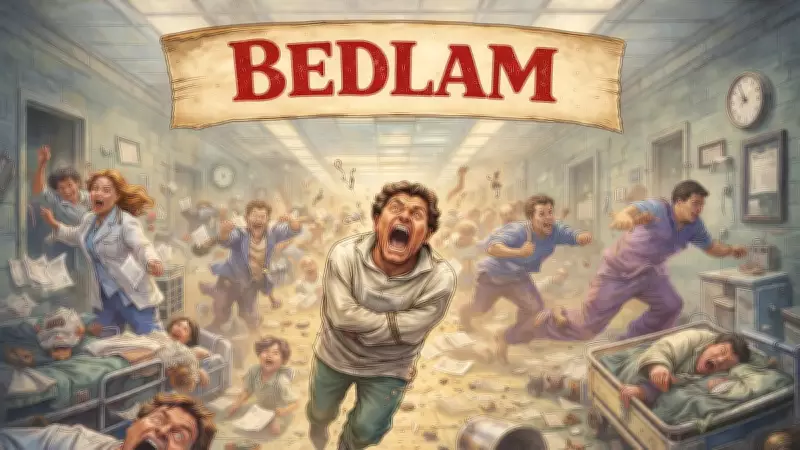
Word of the Day: Bedlam - A Scene of Uproar, Confusion, and Wild Chaos
Unlike many words that have their roots in abstract concepts or ancient languages, "bedlam" is a fascinating example of a term that originates from a specific, real-world location. This word, commonly used to describe a scene of uproar, confusion, and wild chaos, has a history that traces back to The Bethlem Royal Hospital, an institution with a storied past.
The Origins in Bethlem Royal Hospital
The term "bedlam" is a corruption or colloquial adaptation of "Bethlem," which refers to The Bethlem Royal Hospital, one of the oldest psychiatric hospitals in the world, located in London. Founded in the 13th century, this hospital became notorious for its chaotic and often harsh conditions, particularly during periods when mental health treatment was poorly understood and implemented.
Over time, the name Bethlem evolved into "bedlam" in everyday speech, as people began to associate the hospital's tumultuous environment with general scenes of disorder and madness. This linguistic shift highlights how place names can become embedded in language, taking on new meanings that reflect societal perceptions and experiences.

Evolution and Usage in Modern English
Today, "bedlam" is widely used in English to describe any situation marked by extreme noise, confusion, or lack of control. It can apply to various contexts, such as:
- Sports events where crowds are rowdy and unpredictable.
- Political rallies that descend into chaos and shouting matches.
- Everyday scenarios like a busy marketplace or a hectic household with children.
The word has transcended its original association with the hospital, becoming a versatile descriptor for chaos in both formal and informal settings. Its usage underscores the dynamic nature of language, where historical references can shape contemporary vocabulary in profound ways.
Cultural and Historical Significance
The story of "bedlam" is not just about etymology; it also reflects broader historical attitudes towards mental health and institutional care. The Bethlem Royal Hospital, often referred to as Bedlam in historical texts, was a symbol of the mistreatment and misunderstanding of mental illness for centuries. By the 18th and 19th centuries, it had become a tourist attraction where visitors would gawk at patients, further cementing its reputation for disorder.
This legacy has contributed to the word's enduring power in the English lexicon. It serves as a reminder of how language can carry the weight of history, embedding societal flaws and transformations into everyday speech. Understanding the origins of "bedlam" enriches our appreciation of its modern usage, connecting past realities with present expressions.
In summary, "bedlam" is more than just a synonym for chaos; it is a linguistic artifact that bridges history and language. From its roots in The Bethlem Royal Hospital to its current role in describing tumultuous scenes, this word exemplifies how specific places can leave an indelible mark on our vocabulary, shaping how we communicate about disorder and confusion in the world around us.