India's Classical Dance Forms: The Living Texts of Heritage
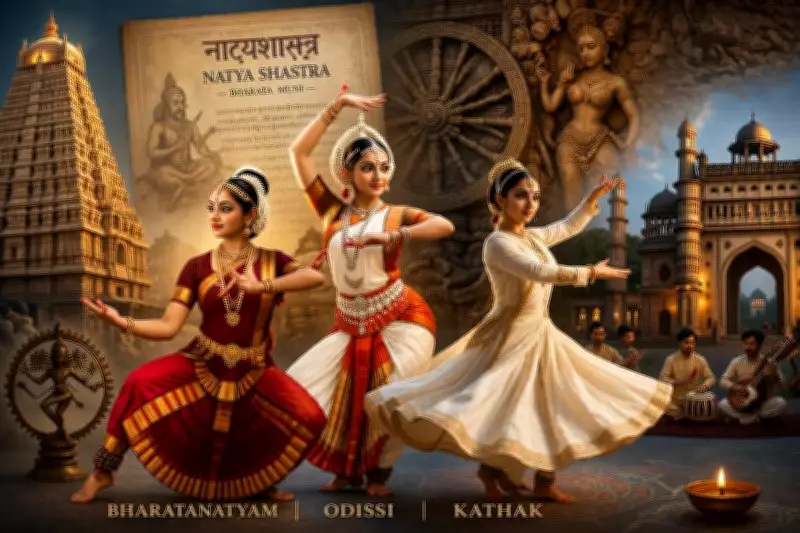
India's rich cultural tapestry is vividly woven through its eight classical dance forms, which stand as dynamic and living texts of history, mythology, and national identity. Recognized by the Sangeet Natak Akademi, these art forms—Bharatanatyam, Kathak, Kathakali, Kuchipudi, Odissi, Manipuri, Mohiniyattam, and Sattriya—transcend mere performance to embody the soul of Indian civilization.
Historical Roots and Mythological Narratives
The origins of these dances are deeply embedded in ancient texts like the Natya Shastra, dating back to the 2nd century BCE. They were traditionally performed in temples and royal courts, serving as mediums to narrate epics such as the Ramayana and Mahabharata, and to depict stories of deities like Shiva, Vishnu, and Krishna. Each movement, gesture, and expression is meticulously codified, with mudras (hand gestures) and abhinaya (facial expressions) conveying complex emotions and tales.
For instance, Bharatanatyam from Tamil Nadu is known for its geometric precision and spiritual themes, while Kathak from North India emphasizes rhythmic footwork and storytelling. Kathakali from Kerala uses elaborate costumes and makeup to portray mythological characters, and Odissi from Odisha is celebrated for its fluid, sculptural poses inspired by temple art.

Preservation of National Identity
Beyond entertainment, these dance forms play a crucial role in preserving India's national identity. They reflect regional diversity yet unite under a common cultural heritage, promoting values like dharma (righteousness) and bhakti (devotion). In the post-independence era, efforts by institutions and artists have revived and standardized these dances, ensuring their transmission to future generations.
Today, classical dances are integral to festivals, educational curricula, and international cultural exchanges, showcasing India's soft power globally. They adapt to contemporary themes while maintaining traditional essence, thus remaining relevant in modern society.
Challenges and Future Prospects
Despite their significance, challenges such as commercialization, lack of funding, and diminishing practitioner numbers threaten their authenticity. However, initiatives by the government and cultural organizations aim to safeguard these art forms through grants, documentation, and promotion.
In conclusion, India's classical dances are not just artistic expressions but living chronicles that connect the past with the present, enriching the nation's cultural landscape and identity.