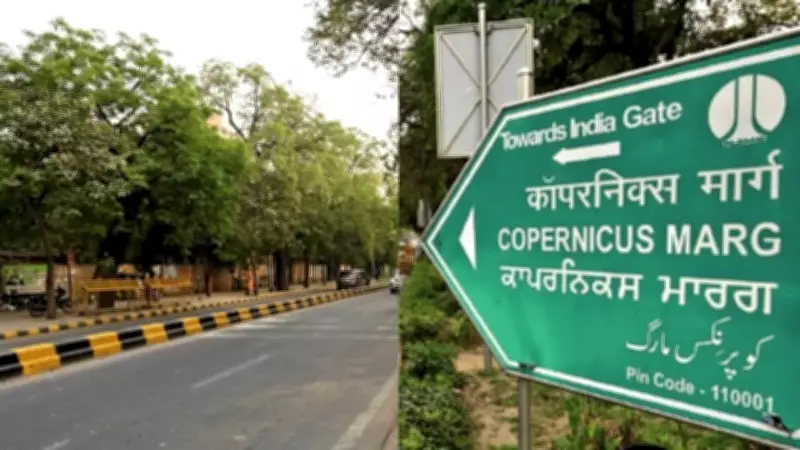
Delhi's Copernicus Marg: More Than Just a Road
From an aerial view, Copernicus Marg extends like a spoke from the India Gate roundabout, a simple line on a map. However, at ground level, it transforms into a vital artery of central Delhi, bustling with life and lined with significant cultural landmarks. For daily commuters and visitors alike, the name often sparks curiosity: Who was Copernicus, and why does this prominent road in India's capital bear his name?
The Renaissance Genius: Nicolaus Copernicus
To unravel this mystery, we must journey back to Renaissance Europe. Born in 1473, Nicolaus Copernicus was a mathematician and astronomer whose groundbreaking ideas forever altered humanity's understanding of the cosmos. At a time when the prevailing geocentric doctrine placed Earth at the center of the universe, Copernicus boldly proposed a heliocentric model, asserting that the Sun occupied the central position, with all planets, including Earth, orbiting around it.
This revolutionary theory was detailed in his seminal work, De revolutionibus orbium coelestium, which challenged centuries of accepted scientific and philosophical thought. Scholars of the history of science emphasize that Copernicus fundamentally reshaped how humans perceived their place in the universe, moving beyond astronomy to influence broader intellectual currents across Europe.

Copernicus's Multifaceted Legacy
Copernicus was not merely an astronomer; he embodied the Renaissance ideal of a polymath. He studied canon law at the University of Bologna but dedicated much of his life to astronomical observations and mathematical modeling while residing in Warmia, present-day Poland. His meticulous work laid the groundwork for future icons like Galileo Galilei and Johannes Kepler, catalyzing the Scientific Revolution.
Beyond astronomy, Copernicus authored Monetae cudendae ratio, a treatise on economics, and advocated for calendar reforms. His interdisciplinary intellect, combining careful observations with rigorous calculations, exemplifies the era's pursuit of knowledge across diverse fields.
Naming Delhi's Roads: A Global Perspective
Historians note that post-Independence Delhi's road-naming practices did not focus exclusively on Indian figures. Instead, they acknowledged global contributors who advanced human knowledge and culture. As historian Swapna Liddle explains, "The naming of such roads is not usually decided at a single moment but tends to coincide with significant events in history, such as major diplomatic developments, visits to India by prominent individuals, or periods of active international engagement."
This approach reflects a broader vision of honoring intellectual and cultural exchange, positioning Delhi as a city connected to global heritage.
Copernicus Marg: A Cultural Hub
Fittingly, Copernicus Marg runs through the vibrant cultural hub near Mandi House, home to institutions like Kamani Auditorium and Shriram Bharatiya Kala Kendra. This area thrives on artistic expression, performances, and intellectual dialogues, mirroring the curiosity and innovation that defined Copernicus's work. The road serves as a modern-day tribute to a figure whose legacy continues to inspire exploration and creativity.
In essence, Copernicus Marg is more than a transportation route; it is a symbol of Delhi's commitment to celebrating global intellectual achievements, weaving history into the urban fabric of India's capital.