

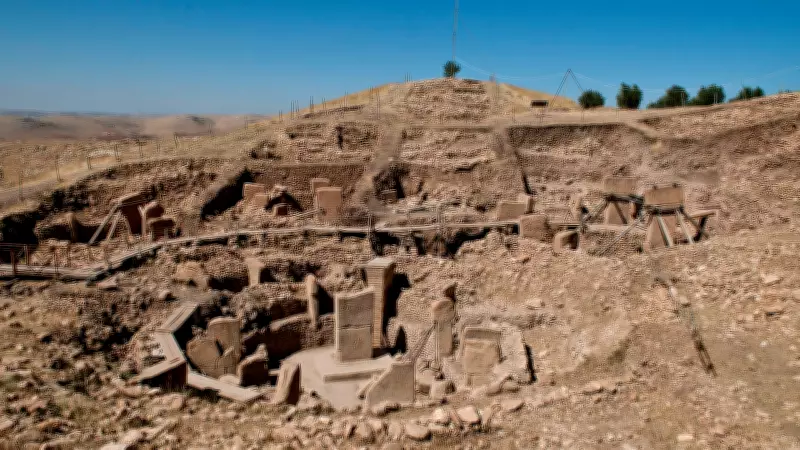
Göbekli Tepe: The 12,000-Year-Old Temple That Redefines Human Civilization
Long before the rise of cities, agriculture, or pottery, a remarkable event unfolded on a hill in what is now southern Turkey. Hunter-gatherers gathered here to create something extraordinary: massive stone pillars, intricately carved with animals and symbols, arranged in grand circular formations. This site, known as Göbekli Tepe, is believed to be the oldest temple ever discovered, dating back nearly 12,000 years. Its existence has forced archaeologists to completely rethink the very beginnings of human civilization.
A Discovery That Shook the Archaeological World
Discovered in the 1990s and extensively studied by German archaeologist Klaus Schmidt, Göbekli Tepe dates to around 9600 BCE, predating Stonehenge and the Egyptian pyramids by millennia. The site features large circular structures with towering T-shaped limestone pillars, some weighing tons and adorned with depictions of animals like foxes, lions, and birds. What makes this truly astonishing is that it was built by hunter-gatherers who had not yet domesticated plants or established settled communities. They survived by foraging, yet somehow managed to orchestrate this monumental construction.
Schmidt described Göbekli Tepe as a "supernova, a moment in time that utterly revolutionises our view of the early history of humans." This temple challenges the long-held belief that farming came first, followed by settlement and then monument-building. Instead, evidence suggests that shared beliefs and rituals may have brought people together, potentially sparking the transition to agriculture. Some scholars argue that the cooperative effort required to build such structures could have been the catalyst for farming, making Göbekli Tepe a pivotal turning point in human history.

The Mysteries of Göbekli Tepe: Burial and Disappearance
One of the most perplexing aspects of Göbekli Tepe is not its creation, but its deliberate burial. Around 8000 BCE, the entire site was intentionally covered with tons of dirt and debris, a man-made act that preserved it for millennia. Theories abound as to why this was done:
- The site may have lost its religious significance over time.
- Cultural or societal shifts could have rendered it obsolete.
- New belief systems might have replaced the old ones.
- It could have been intentionally hidden or preserved for future generations.
Schmidt acknowledged the uncertainty, noting that the burial marked "the end of a very strange culture." Equally mysterious is the fate of the builders. There is no evidence of sudden disaster, war, or exodus. Instead, a gradual decline seems linked to broader changes in human lifestyle. As Göbekli Tepe was being constructed, signs of early farming and settled communities began to emerge. This suggests that the builders did not vanish but evolved, transitioning from ritual gatherings to agricultural societies. Thus, Göbekli Tepe represents both the final chapter of the hunter-gatherer era and the dawn of a new human epoch.
Why Göbekli Tepe Matters Today
Göbekli Tepe is more than just an ancient relic; it is a window into a pivotal moment when humanity stood on the brink of revolution. It underscores that faith, cooperation, and shared goals may have been as crucial to civilization's development as basic survival needs. Today, only a small portion of the site has been excavated, with the majority still buried underground. This means future discoveries could unveil even more secrets, continuing to reshape our understanding of human history.
Ultimately, Göbekli Tepe teaches us that the story of civilization is far more complex and fascinating than previously imagined. It invites us to reconsider the origins of human society and the profound impact of collective belief and effort.

