Navratri Day 1: Goddess Shailputri's Symbolism of Stability and Spiritual Rebirth
The nine-day Navratri festival is a profound spiritual journey where devotees worship nine distinct forms of Goddess Durga. The first day is dedicated to Goddess Shailputri, whose name translates to "daughter of the mountain." This initial worship sets the tone for the entire festival, emphasizing themes of devotion, rebirth, and spiritual stability that resonate through the following days.
The Significance of Beginning with Shailputri
Why does Navratri commence with the daughter of the mountain? Because every meaningful journey requires a solid foundation. The Navratri fast extends beyond mere dietary restrictions; it represents the cultivation of inner resolve that remains unshaken amidst life's distractions. Shailputri's essence continually reminds practitioners of the necessity for a firm inner ground—a quality symbolized by the mountain itself, which stands as an image of stillness, patience, and immovable strength.
The Story of Sati and Lord Shiva: A Tale of Insult and Tragedy
To fully comprehend Shailputri's significance, we must explore her previous incarnation as Sati. Sati was the daughter of Daksha Prajapati and married to Lord Shiva, the ascetic god who represents eternal consciousness and cosmic energy. Daksha disapproved of Shiva's simple, meditative lifestyle and material detachment.

When Daksha organized a grand yajna (fire ritual), he invited all deities except Shiva, deliberately excluding his son-in-law. Despite Shiva's warning that one should never attend where they are unwelcome, Sati insisted on going. At the yajna, she witnessed her husband being profoundly insulted, and overwhelmed by shame and grief, she immolated herself in the ritual fire.
This tragic episode carries a stark lesson: insults can become consuming fires when approached with emotional vulnerability. Shiva's warning remains clear—avoid places where you are not invited—yet devotion and emotion often override caution, leading to devastating consequences.
Rebirth as Parvati: Continuity of Devotion and Purpose
Following her tragic death, Sati was reborn as Parvati, the daughter of Himraj, the King of the Himalayas. The name Parvati itself means "joy," and her presence is associated with festivals and happiness. Remarkably, upon her birth in the mountainous realm, Parvati retained memories of her previous life and her deep devotion to Lord Shiva.
She made a firm resolve to reunite with Shiva and accept him as her husband once again. This rebirth is not portrayed as a casual second chance but as a continuation of devotion and purpose. The narrative shifts from the yajna's grief-stricken setting to the Himalayas' immovable landscape, symbolizing stability and renewal.
Parvati's story illustrates that true devotion is unforgettable—the heart retains what it genuinely cherishes, and purpose persists across lifetimes.
Philosophical Symbolism and Connection to the Mooladhar Chakra
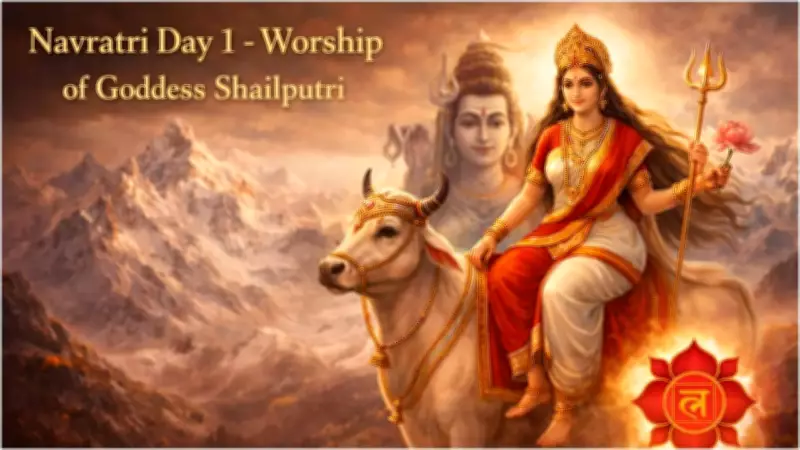
Shailputri's narrative is rich with spiritual and philosophical depth. Philosophically, her quest represents the individual soul's journey toward union with the divine, symbolized here by Lord Shiva as Brahma. The imagery associated with Shailputri powerfully conveys stability: she is depicted riding a bull, an animal traditionally representing steadfastness in Indian culture, and as the daughter of the mountain, an emblem of immovable force.
Due to her grounded and unwavering nature, Goddess Shailputri is closely associated with the Mooladhar Chakra (Root Chakra) in Tantra Yoga tradition. This chakra represents foundation, security, and basic survival instincts. Thus, worshipping Shailputri on Navratri's first day is akin to establishing one's spiritual footing on solid ground.
Spiritual Practice and Modern Relevance
As devotees observe the first day of Navratri, they are encouraged to emulate Shailputri's qualities. This involves cultivating stability in thoughts and actions, remembering her unwavering resolve, and strengthening personal determination for the spiritual journey ahead. The worship rituals typically include offerings of pure ghee, which is believed to strengthen the Root Chakra and promote physical and emotional stability.

In contemporary life, Shailputri's symbolism offers valuable lessons about maintaining inner steadiness amidst chaos, honoring commitments with resolve, and approaching spiritual practices with grounded devotion. Her story reminds us that beginnings matter—starting with stability ensures the journey that follows is purposeful and resilient.
About the Author: AstroDevam is a premium organization providing ancient and authentic knowledge of Astrology, Vastu, Numerology, and innovative corporate solutions with a contemporary perspective. With patrons in over 100 countries, AstroDevam is promoted by Achary Anita Baranwal and Achary Kalki Krishnan, who hold Master's Degrees in Astrology and have been teaching Scientific Astrology, Vastu, and Numerology for more than three decades.