When you reach your comfortable hotel room after a long journey — in this case Bengaluru to Singapore and then onwards to Seoul — there is always a bit of a tussle. The weary traveler battles jet lag, the excitement of a new city, and the temptation to simply collapse onto the plush bedding. But for those who love literature, the real adventure begins not with sightseeing, but with finding the perfect bookstore.
The journey from Bengaluru to Seoul via Singapore
My trip began at Kempegowda International Airport in Bengaluru, a bustling hub that connects South India to the world. After a smooth flight to Singapore's Changi Airport, I had a layover that felt like a mini-holiday in itself. Changi's gardens and butterfly aviary are a treat, but my mind was already on Seoul. The second leg, a five-hour flight to Incheon, was uneventful. Upon landing, I took the AREX express train to Seoul Station, then a short taxi ride to my hotel in the vibrant district of Hongdae.
The hotel, a boutique property near Hongik University, offered a blend of modern comfort and Korean hospitality. As I checked in, the front desk clerk handed me a welcome note and a small book of Korean poetry — a thoughtful touch that set the tone for my trip.

Seoul's literary scene: More than just K-culture
South Korea is often associated with K-pop, K-dramas, and technology, but its literary culture is equally rich. Seoul boasts a myriad of independent bookstores, each with its own character. The most famous is Kyobo Bookstore in Gangnam, a sprawling paradise for book lovers. However, I was drawn to smaller, niche spots like Alive Book Cafe in Hongdae, where you can sip a latte while browsing curated selections of Korean and international titles.
Another gem is Bookpark in the upscale Cheongdam-dong area, known for its art books and design magazines. For those who read Korean, the Gwanghwamun area has several historic bookshops that have been around for decades. But even for non-Korean readers, the experience is immersive — the smell of old paper, the quiet rustle of pages, and the warm lighting create a sanctuary away from the city's neon-lit streets.
Exploring Seoul by the book
To truly travel by the book, I followed a guide I had purchased from a local publisher. It recommended a walking tour through the alleyways of Insadong, where traditional tea houses and art galleries coexist with secondhand bookshops. I stumbled upon Daeo Bookstore, a tiny shop crammed with vintage volumes and handwritten notes from previous owners. The owner, an elderly gentleman, spoke no English but communicated through smiles and gestures. He handed me a worn copy of a Korean folktale — a souvenir more valuable than any mass-produced trinket.
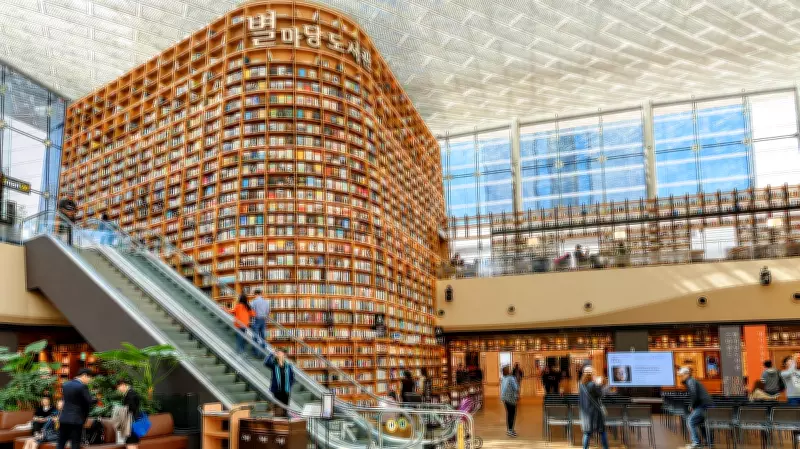
The tour also led me to the Starfield Library in Coex Mall, a stunning public space with towering bookshelves. Though it's a social media hotspot, the sheer scale of the collection is awe-inspiring. I spent an afternoon there, reading about Korean history while occasionally glancing up at the glass ceiling that lets in natural light.
Culinary breaks and literary cafes
No travel story is complete without food. Seoul's cafes often double as reading spots. I visited Makers Cafe in Seongsu-dong, a converted warehouse that serves artisanal coffee and hosts book clubs. The barista recommended a novel by Kim Young-ha, a contemporary Korean author. Over a slice of red velvet cake, I read about Seoul's transformation from a war-torn city to a global capital — a story that mirrored my own journey.
For a more traditional experience, I tried sikhye (sweet rice drink) at a pojangmacha (street tent) near Myeongdong. The vendor, an ajumma, saw my book and asked in broken English, "You like to read?" She then pointed to a nearby secondhand stall where she claimed to have once found a first edition of a classic Korean novel. I didn't find the first edition, but I did pick up a well-loved copy of The Vegetarian by Han Kang, a Booker Prize winner.

The tussle resolved
Back at the hotel that first evening, I finally understood the tussle. The exhaustion from the journey melted away as I opened the poetry book from the front desk. The words, even in translation, spoke of resilience and beauty — much like South Korea itself. By the end of my trip, I had visited over a dozen bookstores, collected a pile of reading material, and gained a deeper appreciation for a country that values the written word as much as its digital innovations.
Traveling by the book isn't just about following a guide. It's about letting literature guide you to unexpected corners, conversations, and experiences. In Seoul, every bookstore has a story, and every story leads to another adventure.