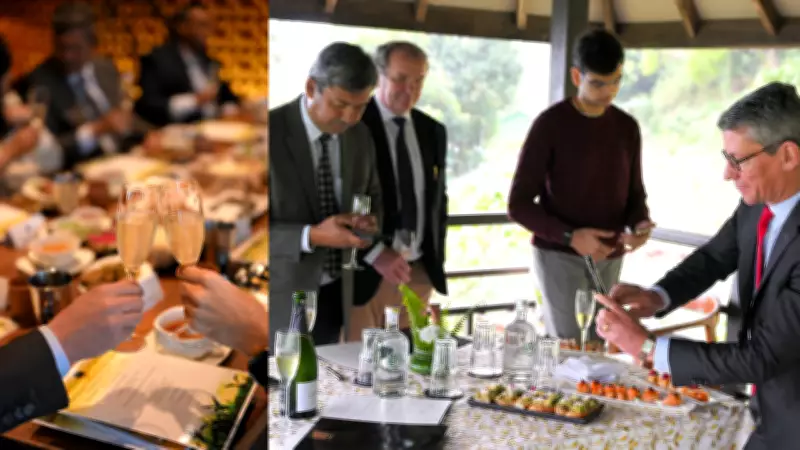
Champagne Delegation's Historic First Visit to India Culminates in Darjeeling Tea Alliance
The mist-shrouded hills of Kurseong in West Bengal recently witnessed an unprecedented convergence of global luxury heritage. For the first time in history, the highest leadership of the Comité Champagne (CIVC)—the unified governing body of France's Champagne industry established in 1941—traveled to India. Co-Presidents Maxime Toubart and David Chatillon, accompanied by Director General Charles Goemaere, arrived at the luxurious Taj Chia Kutir resort to initiate what they described as "heritage diplomacy" with India's legendary tea producers.
A Meeting of Centuries-Old Legacies
Steered by Rajiv Singhal, widely recognized as the Ambassador of Champagne to India and Director of the India Champagne Bureau, the French delegation met with representatives of the Darjeeling Tea Association (DTA). The Indian contingent included veteran estate manager Vikash Gajmer of the historic Makaibari Tea Estate and Arihant Lohia, Director of the Chamong Group. As the youngest member of the leadership group and a seventh-generation tea grower with estates across Darjeeling and Assam, Lohia's presence bridged the gap between the industry's 19th-century origins and its 21st-century global aspirations.
The French visitors experienced the full spectrum of Himalayan hospitality during their stay, residing both at Makaibari estate's storied colonial-era Bungalow and the luxurious Taj Chia Kutir, which is nestled directly within biodynamic tea gardens.

Two Decades of Preparation Culminate in Strategic Partnership
Director General Charles Goemaere revealed that this visit represented the culmination of a twenty-year personal interest. "I was inspired to explore Darjeeling's famed tea estates when I welcomed a group of Darjeeling producers in Champagne two decades ago," Goemaere reflected. "With the backdrop of the Free Trade Agreement negotiations between India and the European Union, I recognized an opportunity to revisit my original idea of sharing knowledge and expertise. This visit represents a concrete step toward taking the Darjeeling tea and Champagne story forward together."
Historic Declaration to Protect Geographical Indications
The central focus of the meeting was protecting the "identity and legacy" of both Champagne and Darjeeling tea—two of the world's most celebrated Geographical Indications (GIs). Co-President David Chatillon described the resulting declaration as historic, noting it was specifically drafted with an eye toward future collaboration where both the DTA and CIVC could explore mutual knowledge sharing and protection strategies.
Co-President Maxime Toubart highlighted the structural success of the French model, observing how the CIVC has successfully brought together growers, owners, and other stakeholders for a singular purpose over decades. He suggested that a similar unified front could help "protect the ecosystem of Darjeeling tea, and preserve and perfect its legacy" against global market pressures.
Exploring Common Ground in the Luxury Market
The dialogue concluded with a strong emphasis on the future of tea in the global luxury market. Rajiv Singhal noted that "the hospitality industry especially would play an important role in creating awareness about the potential of Darjeeling tea as a luxury and connoisseur's choice—much like Champagne has achieved worldwide."
Arihant Lohia, representing the younger generation of tea growers, expressed his keen interest in finding common ground to navigate what he described as a challenging phase for the industry. "The use of smart technology and creating products and experiences to cater to an increasingly discerning audience is the need of the hour," he emphasized.
In an official press release, the Comité Champagne stated: "Champagne and Darjeeling embody excellence and share the same standard: that of an inseparable link between a product, territory and craftsmanship—values strongly advocated in the new trade framework."

Immersive Experience at the World's First Tea Factory
The French delegation spent considerable time exploring the Makaibari Tea Factory and its surrounding gardens. Established in 1859, this remarkable facility holds the distinction of being the world's first tea factory. Now in its 167th year of operation, the structure remains a marvel of industrial archaeology—a rare architectural gem built entirely from wood, bamboo, and cast iron, deliberately eschewing the concrete typical of later industrial sites to maintain harmony with its high-altitude environment.
The CIVC members received an extensive tour of the craft-driven methodology that has remained largely unchanged for over a century. Remarkably, many of the original cast-iron machines are still in active use today, meticulously maintained to process the estate's world-famous biodynamic tea leaves. This living museum of tea production provided tangible evidence of the heritage both industries seek to preserve through their new partnership.