

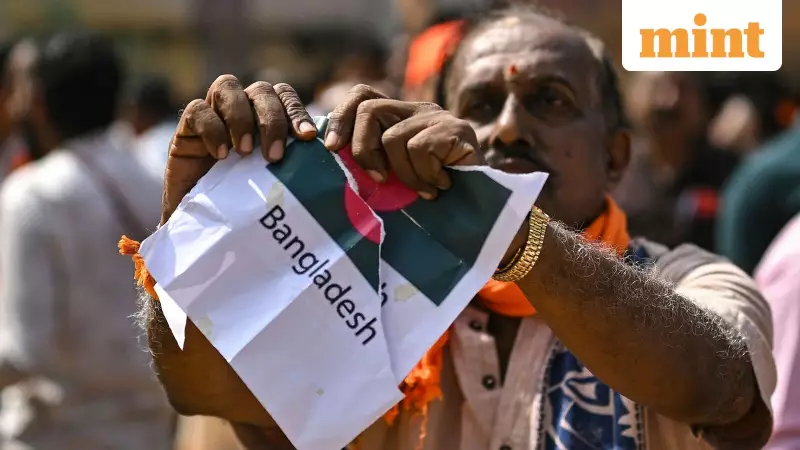
Leaders and activists of the Inqilab Manch in Bangladesh have issued a series of strong demands, including the revocation of work permits for Indian nationals employed in the country. This call comes amidst the ongoing controversy and public outcry following the assassination of the group's spokesperson, student leader Shaheed Osman Hadi.
Four-Point Ultimatum Issued
Abdullah Al Jaber, the member secretary of the Inqilab Mancha, publicly announced a four-point charter of demands. He stated that the demands were essential to secure justice for Hadi's murder and to protect Bangladesh's independence and sovereignty. The demands, as reported by the Bengali daily Prothom Alo, are as follows:
- The immediate arrest and prosecution of all individuals involved in Hadi's killing—including the perpetrators, planners, and accomplices—must be completed within the next 24 days.
- All work permits granted to Indian citizens working in Bangladesh must be cancelled to safeguard national sovereignty.
- A case should be filed against India in the International Court of Justice if former Prime Minister Sheikh Hasina, who reportedly fled to India after the 2024 student uprising, does not return to Bangladesh.
- Individuals within the civil administration, military, and intelligence agencies who are allies of the Awami League must face legal action.
Jaber emphasized that while the primary focus is on Hadi's killers, the interim government must also fulfill the remaining three demands.

Protests and Blockades for Justice
The political atmosphere in Dhaka remains charged. Members of the Inqilab Manch initiated a sit-in protest at the capital's Shahbagh intersection starting Friday afternoon, calling for the arrest and trial of those responsible for Hadi's death. The protest escalated on Saturday night when Jaber declared a full-scale blockade in divisional cities to amplify their movement. The blockade was called off on Sunday night following the announcement of the four demands.
The Killing that Sparked the Crisis
Sharif Osman Hadi, the 32-year-old spokesperson for the Inquilab Moncho, was shot on December 13, a day after the Election Commission set February 12 as the date for the next national election. A prominent youth leader, Hadi played a key role in the mass street protests of July-August 2024, which ultimately led to the fall of the Sheikh Hasina-led government. He was also a candidate for the upcoming parliamentary elections.
After the attack, Hadi was airlifted to Singapore for advanced medical care but succumbed to his injuries on the night of December 18.
Cross-Border Claims and Denials
The investigation into Hadi's murder has taken an international dimension, with implications for India-Bangladesh relations. A senior Dhaka Metropolitan Police officer claimed that two primary suspects in the case had crossed into the Indian state of Meghalaya via the Haluaghat border, allegedly with local assistance. The Garo Hills region of Meghalaya shares a porous international border with Bangladesh, which is patrolled by the Border Security Force (BSF).
However, Indian security agencies have firmly rejected these claims. Inspector General BSF Meghalaya, OP Opadhyay, told PTI that there was no evidence to support the assertion that anyone crossed the border from the Haluaghat sector. "The BSF has neither detected nor received any report of such an incident. The claims being circulated are unfounded and misleading," he stated on Sunday. This contradiction adds another layer of complexity to the already tense situation between the two neighbouring nations.






