

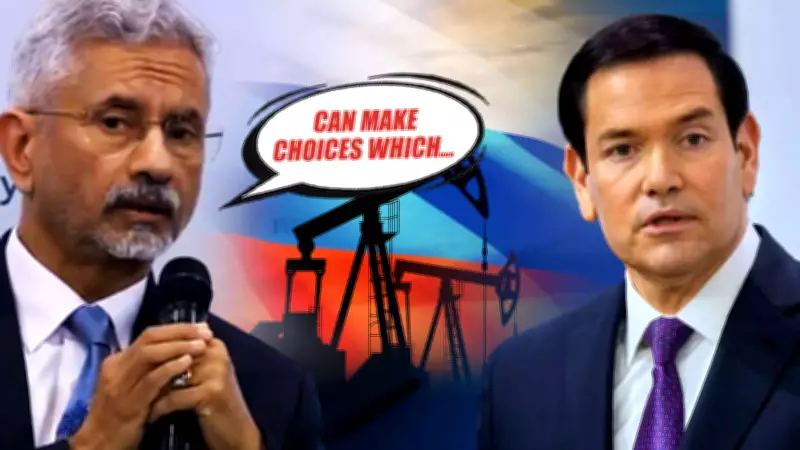
India Firmly Committed to Strategic Autonomy, Says EAM Jaishankar Amid US Oil Claims
External Affairs Minister S Jaishankar has unequivocally stated that India remains deeply wedded to its long-standing policy of strategic autonomy, addressing recent assertions from the United States regarding Russian oil imports. Speaking at the prestigious Munich Security Conference, Jaishankar underscored that this principle is not merely a contemporary stance but is intricately woven into the fabric of India's historical and political identity.
Jaishankar's Response to US Claims on Russian Oil
During his appearance alongside German Foreign Minister Johann Wadephul, Jaishankar tackled questions about India's energy procurement strategies head-on. He described the global energy market as an exceptionally complex ecosystem, where Indian oil companies base their purchasing decisions on a multifaceted analysis of availability, costs, and associated risks. When directly queried about whether India would cease buying Russian crude, Jaishankar firmly declared that India would persist in making independent choices that best serve its national interests.
Context of US Secretary of State Marco Rubio's Statement
Jaishankar's remarks came in the wake of a statement by US Secretary of State Marco Rubio, who claimed that India had agreed to halt additional purchases of Russian oil. This assertion sparked significant diplomatic discourse, prompting Jaishankar to clarify India's position on the international stage. By reiterating the nation's commitment to strategic autonomy, he aimed to dispel any misconceptions about India's foreign policy being swayed by external pressures.

The Core of India's Strategic Autonomy Policy
Strategic autonomy, as emphasized by Jaishankar, is a cornerstone of India's approach to global affairs. It allows the country to navigate intricate international relations while prioritizing its own economic and security needs. This policy is particularly crucial in the realm of energy security, where India must balance diverse geopolitical interests to ensure stable and affordable energy supplies for its vast population of over 1.4 billion people.
Jaishankar's defense of this autonomy highlights India's resolve to maintain sovereignty in its decision-making processes, even amid growing global tensions and competing superpower demands. His statements at the Munich Security Conference serve as a powerful reminder of India's independent stance in an increasingly polarized world.






