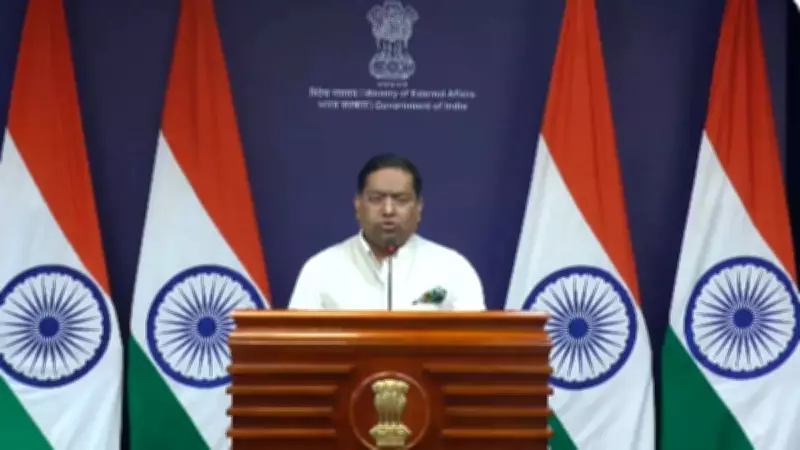
India on Monday launched a sharp rebuttal against Pakistan President Asif Ali Zardari over his remarks on minority rights, pointing to what it called Pakistan's own abysmal record in protecting its minority communities. The Ministry of External Affairs (MEA) spokesperson Randhir Jaiswal said that Zardari's comments were 'unwarranted' and came from a country that has systematically failed to safeguard the rights of its religious and ethnic minorities.
India's Strong Response to Zardari's Remarks
The MEA spokesperson stated, 'President Zardari's remarks on minority rights are baseless and come from a nation that has a documented history of persecution of minorities. The plight of Hindus, Sikhs, Christians, and other minority groups in Pakistan is well-known, with forced conversions, targeted violence, and institutional discrimination being rampant.'
Jaiswal further added that India has always upheld the rights of all its citizens regardless of religion, and that the Constitution guarantees equality and freedom to every individual. 'India's secular fabric and commitment to minority rights are exemplary, unlike the situation in Pakistan where minorities continue to face systematic oppression.'

Pakistan's Abysmal Record on Minority Rights
India highlighted several instances of minority persecution in Pakistan, including the forced conversion of Hindu girls, attacks on Sikh gurdwaras, and the demolition of Christian churches. According to reports, the number of Hindus in Pakistan has declined from 23% at the time of partition to less than 2% today, indicating a systematic marginalization.
In 2023 alone, there were over 50 reported cases of forced conversions of minority women in Pakistan, according to human rights groups. The country's blasphemy laws are frequently misused to target minorities, with over 1,400 people accused under these laws since 1987, many of whom are from minority communities.
India's Commitment to Minority Rights
The MEA emphasized that India has robust legal and institutional frameworks to protect minorities. The National Commission for Minorities, the National Human Rights Commission, and various state-level bodies work to ensure the welfare of minority communities. India's Muslim population, the third-largest in the world, enjoys full rights and freedoms, with many holding high offices.
Furthermore, India's secular constitution and policies have ensured that minorities are not only protected but also thrive. The country has seen a significant increase in the number of minority-owned businesses, educational institutions, and political representation.
Diplomatic Implications
This exchange comes amid strained relations between India and Pakistan, with India consistently raising concerns over cross-border terrorism and human rights abuses in Pakistan. The MEA's strong response underscores India's stance that Pakistan is in no position to lecture others on minority rights when its own record is deeply flawed.
India also urged Pakistan to focus on improving the conditions of its own minorities rather than making baseless allegations against India. 'We advise Pakistan to introspect and take concrete steps to protect the rights of its minority communities before commenting on others,' the MEA spokesperson concluded.