

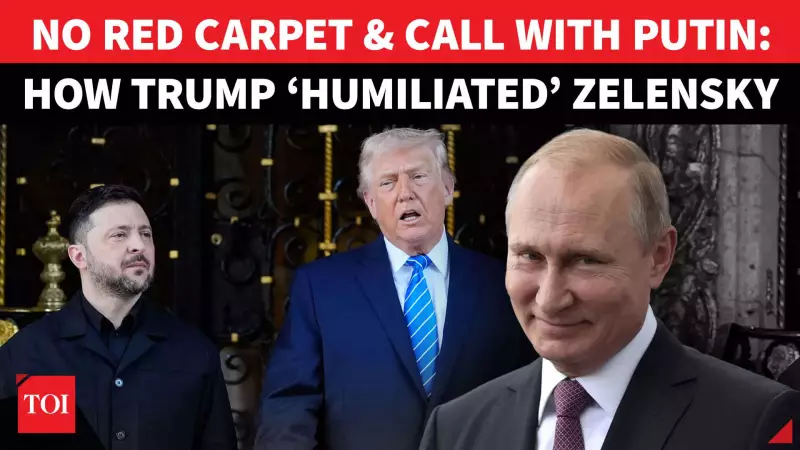
A significant diplomatic sequence involving the United States, Russia, and Ukraine has ignited intense scrutiny and debate over Washington's strategic priorities. The focal point is U.S. President Donald Trump's decision to hold a lengthy conversation with Russian President Vladimir Putin immediately before hosting Ukrainian leader Volodymyr Zelensky.
The Timing and The Call
The crucial event unfolded on December 29, 2025. President Trump engaged in an hour-long telephone call with President Vladimir Putin. Official statements from Moscow described the discussion as "constructive," though specific details of their conversation were not fully disclosed. This direct communication occurred just ahead of Ukrainian President Volodymyr Zelensky's arrival in the United States for planned talks.
The proximity of the two events raised immediate questions. President Zelensky's visit to the U.S. was notably devoid of the typical formalities extended to a visiting head of state. Reports confirmed he received no official welcome ceremony or ceremonial reception, a departure from standard diplomatic protocol that added another layer of symbolism to the situation.

Diplomatic Optics and Interpretations
The order of operations—speaking with the leader of the nation that invaded Ukraine before meeting with the Ukrainian president himself—sent a powerful message. Analysts and observers interpreted the move as a clear signal of Washington's approach to ending the conflict. It appeared to emphasize direct dialogue with Moscow as a primary channel, even as talks with Kyiv were still pending.
This was not merely about protocol; it was widely seen as a deliberate act of power politics and pressure signaling. The timing suggested the Trump administration was prioritizing its engagement with Putin, potentially to leverage the call in subsequent discussions with Zelensky. The act resonated deeply within diplomatic circles, fueling debates about the balance of support for Ukraine amidst pushes for a ceasefire.
Broader Implications and Reactions
The incident has intensified the global debate on how major powers navigate the Ukraine war. The diplomatic maneuver has sparked discussions on several critical fronts:
- Prioritization: Does the call sequence indicate a shift in the U.S.'s diplomatic focus regarding the conflict?
- Pressure Tactics: Was this a method to apply indirect pressure on Kyiv by demonstrating Washington's open line to the Kremlin?
- Ceasefire Push: The event underscores the complex and high-stakes diplomacy surrounding efforts to secure a truce, with the U.S. seemingly taking a direct, top-down approach.
While the substance of the Trump-Putin discussion remains partially private, its consequences are publicly evident. It has introduced a new dimension of global tensions into an already volatile situation, highlighting the intricate and often theatrical nature of international statecraft where every gesture is meticulously analyzed.






