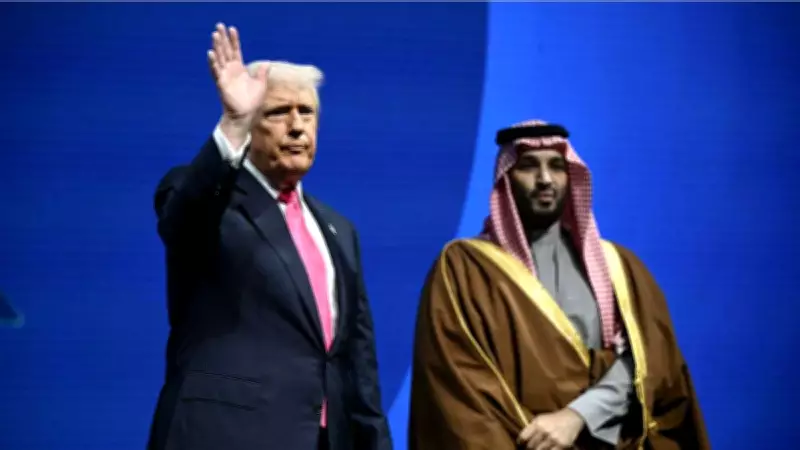
Former US President Donald Trump has proposed linking a civilian nuclear cooperation agreement with Saudi Arabia to the expansion of the Abraham Accords, a move that could reshape Middle East diplomacy and affect India's strategic calculus. The proposal, outlined in recent statements, ties Saudi nuclear ambitions to normalization with Israel, a condition that echoes earlier US policy but adds a new dimension to regional geopolitics.
The Proposal and Its Background
Under Trump's plan, the United States would assist Saudi Arabia in developing a civilian nuclear program, including enrichment capabilities, only if Riyadh agrees to normalize ties with Israel under the Abraham Accords framework. The Abraham Accords, brokered by the Trump administration in 2020, saw the United Arab Emirates, Bahrain, Sudan, and Morocco establish diplomatic relations with Israel. Saudi Arabia, the largest Arab state, has so far refrained from joining amid domestic and regional pressures.
The proposal revives a contentious issue: Saudi Arabia's insistence on its right to enrich uranium for civilian purposes. US law requires a 123 Agreement, which must include non-proliferation standards. Previous negotiations under the Biden administration have stalled over this point. Trump's linkage introduces a political condition that could accelerate Saudi-Israel normalization but also raises proliferation risks.

Implications for India's Middle East Strategy
India has maintained a balanced approach in the Middle East, fostering ties with all key players, including Saudi Arabia, Israel, and Iran. A Saudi-Israel normalization under US auspices could deepen the India-Israel-Saudi triangle, which is crucial for India's energy security and strategic autonomy. India imports about 20% of its crude oil from Saudi Arabia and relies on Israel for advanced defense technology.
Moreover, a Saudi nuclear deal might influence India's own negotiations with the US for nuclear cooperation, particularly regarding the liability law. India's 2008 nuclear deal with the US was a landmark, but subsequent liability legislation (Civil Liability for Nuclear Damage Act, 2010) has hindered further cooperation. If Saudi Arabia secures enrichment rights, it could set a precedent that India might leverage.
According to geopolitical analysts, India's 'Act West' policy integrates the Gulf into its Indo-Pacific vision. A stronger Saudi-Israel relationship could enhance maritime security in the Indian Ocean, given Saudi Arabia's strategic location. However, it might also complicate India's ties with Iran, a key supplier of crude and a partner in the Chabahar port project.
Regional Reactions and Challenges
The proposal has received mixed reactions. Israel has long sought normalization with Saudi Arabia, viewing it as a game-changer. The Trump camp sees it as a foreign policy victory, but critics argue it undermines non-proliferation efforts. Saudi Arabia has not officially responded, but its de facto ruler, Crown Prince Mohammed bin Salman, has prioritized economic transformation under Vision 2030, which requires stable energy markets.
Iran, a regional rival, has condemned any nuclear deal that enriches Saudi Arabia, fearing a nuclear arms race. The US non-proliferation community warns that allowing enrichment increases the risk of weapons development, even with safeguards.
Conclusion
Trump's linkage of the Saudi nuclear deal to the Abraham Accords is a high-stakes diplomatic gambit. For India, it presents both opportunities and challenges. While it could bolster the India-Israel-Saudi axis and open new avenues for energy and defense cooperation, it must navigate the shifting dynamics carefully to preserve its strategic autonomy in the region.