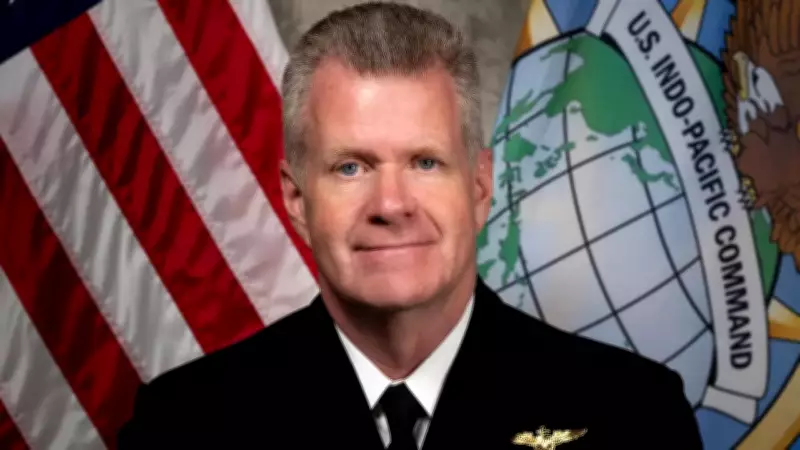
US Indo-Pacific Commander Lauds India's Military Tactics During Operation Sindoor
NEW DELHI: During a significant visit to India on Sunday, Admiral Samuel J. Paparo, the commander of the United States Indo-Pacific Command, expressed high praise for the tactical execution of Indian military operations against Pakistan in the aftermath of the Pahalgam terror attack, widely referred to as Operation Sindoor. The Admiral emphasized that every global conflict offers valuable lessons, underscoring the importance of learning from such events.
Admiral Paparo Commends Restraint and Tactical Precision
In response to a query about his views on Operation Sindoor, Admiral Paparo, while interacting with a select group of journalists, stated, "First of all, I have tremendous reverence for the terrible event that preceded the crisis. In my discussions with my partners, I applaud the tactical execution of the operations. We also sincerely applaud the restraint that was exhibited. We hope to work together to ensure such a terrible event does not happen again." He further noted observing a deep commitment from the Indian military to extract lessons from this conflict, highlighting the professionalism and strategic acumen displayed.
Lessons Learned and Concerns Over Chinese Weapons
When asked about the lessons the United States derived from Operation Sindoor, particularly regarding the use of Chinese weapons by Pakistan, Admiral Paparo pointed out, "Complex long-range weapons have complex long-range kill chains." He elaborated that in the 21st century, with advancements in sensors, communication, propulsion, warheads, and seekers, geography no longer serves as a protective commodity, making modern warfare more intricate and demanding.

Strengthening US-India Defense Partnership
Admiral Paparo described the US-India defense relationship as being on a "steeply upward trajectory," despite expressing concerns about increasing coercion and aggression in the Indo-Pacific region. He emphasized that deterrence remains the highest duty, requiring preparedness for worst-case scenarios. "India shares some of those concerns in the Indo-Pacific, as the region is home to 60% of the world’s population, more than 60% of the world’s GDP, and seven of the world’s largest militaries," he added.
Commitment to Sovereignty and Maritime Security
The Admiral highlighted the mutual respect and sovereign relationship between the United States and India, both committed to principles such as sovereignty, freedom of navigation, and freedom of the seas. "We applaud India as a great net contributor to the security of the Indian Ocean region," he stated. Both nations are actively exploring enhanced maritime security cooperation, including advancements in undersea domain awareness, to bolster regional stability.
Joint Exercises and Future Collaborations
With the impending MILAN exercise in focus, Admiral Paparo remarked on the deepening Indo-US defense partnership, solidified by the recent defense agreement signed in Kuala Lumpur on October 31, 2025, between US Secretary of War Pete Hegseth and Indian Defense Minister Rajnath Singh. He listed several joint exercises that are strengthening bilateral ties:
- Yudh Abhyas in Alaska
- MILAN series
- Malabar series
- COPE India exercise
- Tiger Triumph series
These initiatives, along with robust people-to-people contacts, are fostering a treasured relationship between the two democracies.
Embracing Modern Warfare and AI Integration
On the subject of modern warfare strategies, Admiral Paparo predicted that the 21st century will be dominated by actors who master the information environment, encompassing space, counter-space, electronic warfare, low observability, and other cutting-edge technologies. Regarding India's upcoming AI summit, he praised Prime Minister Narendra Modi's visionary approach, stating, "I celebrate India’s vision on how to make use of AI in the 21st century. AI has many defense connections, and the United States Indo-Pacific Command is at the forefront of AI employment for defense."

This comprehensive dialogue underscores the strategic alignment between the United States and India in addressing regional security challenges while advancing defense cooperation through innovation and shared values.