

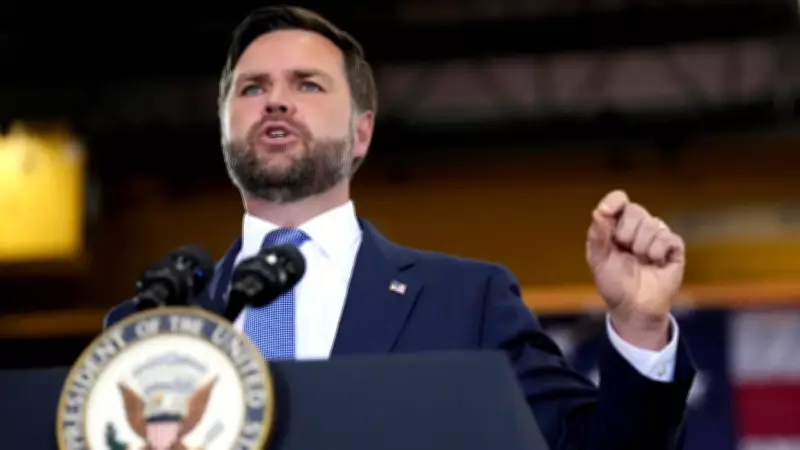
US Vice President JD Vance Embarks on Critical Diplomatic Mission to Pakistan
US Vice President JD Vance is set to arrive in Pakistan on Saturday morning, leading a concerted diplomatic push aimed at corralling Iran and containing a widening conflict that has deviated from Washington's strategic plans. This high-stakes visit comes as the Trump administration seeks to salvage gains from a war it has militarily won but risks losing the peace, with Tehran digging in its heels despite significant military setbacks.
Vance's Calibrated Approach and Iran's Preconditions
On the eve of his departure, Vice President Vance struck a nuanced tone, blending caution with conditional engagement. He stated, "If the Iranians are willing to negotiate in good faith, we're certainly willing to extend the open hand. If they're going to try to play us, then they're going to find that the negotiating team is not that receptive." This formulation reflects Vance's long-standing scepticism of war, a stance crucial for his political future, while signalling firmness in walking the fine line between deterrence and diplomacy.
However, Iran has set preconditions that complicate the mission. The speaker of Iran's parliament has declared that Tehran will not begin negotiations in Pakistan unless two demands are met: a ceasefire in Lebanon and the release of Iran's blocked financial assets. The US is not yet ready to concede to these conditions, adding layers of complexity to the diplomatic efforts.

Regional Tensions and US Response
Even as diplomacy gathers pace, tensions remain high in the Strait of Hormuz. Iran's reported moves to demand payments from some transiting vessels—widely seen as violating international maritime norms—have spooked the global community. Washington has demanded an immediate cessation of such practices, framing them as a threat to global commerce and freedom of navigation. Yet, enforcement remains a complex issue, particularly as the US aims to avoid further military entanglement while maintaining credibility.
Political Dynamics and Vance's Central Role
Vance's central role in this mission is perhaps the most revealing aspect of the current moment. Traditionally, such high-stakes diplomacy would be led by the Secretary of State—currently Marco Rubio. Instead, President Trump has turned to his vice president, effectively sidelining the country's top diplomat. This move contrasts sharply with the posture of Defence Secretary Pete Hegseth, whose advocacy of a "warrior ethos" has shaped the administration's military response.
Some analysts in Washington have sarcastically commented, "Trump and Hegseth have won the war and are sending Vance to Pakistan to negotiate our terms of surrender." While exaggerated, such sentiments reflect a growing perception that the administration's military successes have not translated into strategic gains, leaving Vance to resolve a conflict with an unclear political endgame.
Domestic and International Challenges
President Trump has offered a characteristically cryptic framing, posting on social media that the unfolding situation represents the "most powerful reset in the world." The White House added that Trump is "optimistic that a deal can be reached that can lead to lasting peace in the Middle East," citing his "proven track record" of securing agreements that "put America first."
Trump has repeatedly suggested that Washington is engaging with a more "receptive" faction within Iran's negotiating apparatus, hinting at possible cracks between pragmatists and hardliners. However, regional analysts see little evidence of such divisions, viewing the claim as wishful thinking or an attempt to sow discord within Iran's leadership.
The political context surrounding Vance's mission is equally challenging. Public appetite for escalation is limited in the US, and anti-war sentiment is no longer confined to progressive circles. Within Trump's own MAGA base, a growing number of voices—including influential commentators—have expressed unease about the conflict's trajectory, irking the President. This emerging scepticism has created an unusual convergence, with segments of both the right and left questioning the costs of continued engagement.

Vance's Political Positioning and Future Implications
Vance, who has consistently warned against "forever wars," is uniquely positioned to channel this mood and enhance his political future. His involvement signals an acknowledgement by the White House that domestic political constraints are beginning to shape foreign policy decisions as much as battlefield dynamics. As he navigates this delicate mission, the outcome could have significant implications for US-Iran relations and regional stability in the Middle East.





