

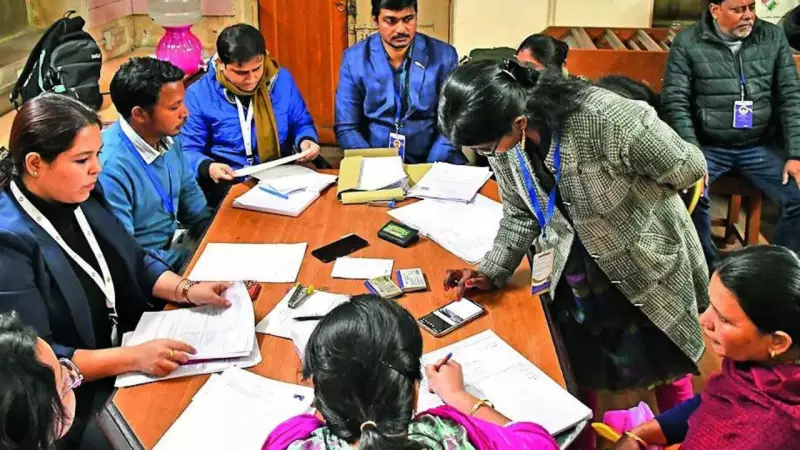
West Bengal's electoral roll update, known as the Special Summary Revision (SIR), has descended into chaos two months after its launch. Citizens are fighting to retain their fundamental voting rights amid widespread confusion, contradictory official orders, and procedural errors. The situation has prompted Chief Minister Mamata Banerjee to urgently appeal to the Election Commission of India.
CM Mamata's Stern Letter to Election Commission
On Saturday, Chief Minister Mamata Banerjee wrote a strong letter to Chief Election Commissioner (CEC) Gyanesh Kumar. She demanded that the poll panel either "rectify glitches" or halt the "unplanned, arbitrary and ad-hoc" SIR process immediately. This marked her fourth communication to Kumar since the exercise began. Banerjee questioned why Bengal was being "singled out" for what she termed "arbitrary and illegal" voter deletions.
In her letter, the CM highlighted several critical issues. She pointed out that the family register, accepted as valid proof in Bihar's SIR, was being denied in Bengal. She also stated that residence certificates issued by state authorities were being rejected. Banerjee accused the EC of insensitivity, noting that "elderly, infirm, and seriously ill citizens are not being spared" from being summoned to distant hearings.

Ground Reality: Citizens Bear the Brunt of Confusion
The human cost of the administrative mess is stark. Eighty-year-old Jayanti Devi, burdened with medicines and documents, stood confused outside a hearing camp at Kolkata's Chetla Boys' High School. Despite having voted for decades, she was asked for a second hearing with an old ration card or her parents' documents. Her son revealed they were unaware of the EC's order exempting voters above 85 and those who are sick or disabled from such hearings.
In another case, Sister John Paul of the Missionaries of Charity faced a hearing because she listed Sister Nirmala, her order's then superior general, as a guardian on her voter document—a standard practice for nuns. The 46-year-old, who came to Bengal in 2002 (the SIR's reference year), described the situation as "absolute chaos." Around ten nuns from her order have received similar notices.
Further illustrating the errors, voter Roma Samanta from Kolkata's Rashbehari area was confused with a namesake from Kaliaganj, over 400 km away in North Dinajpur district, forcing her family to seek redress.
EC's Response and the Path Ahead
Amid growing public outcry, the Election Commission announced the establishment of 160 additional SIR hearing centres, primarily in north Bengal. Officials stated these new centres would consider geographical constraints and reduce travel distances for voters.
However, core issues remain. Banerjee's letter emphasized that many voters are being forced to travel 20-25 km to centralized hearings instead of accessing decentralized facilities. With the integrity of the electoral roll at stake, the resolution of these glitches is crucial for upholding democratic rights in the state.






