

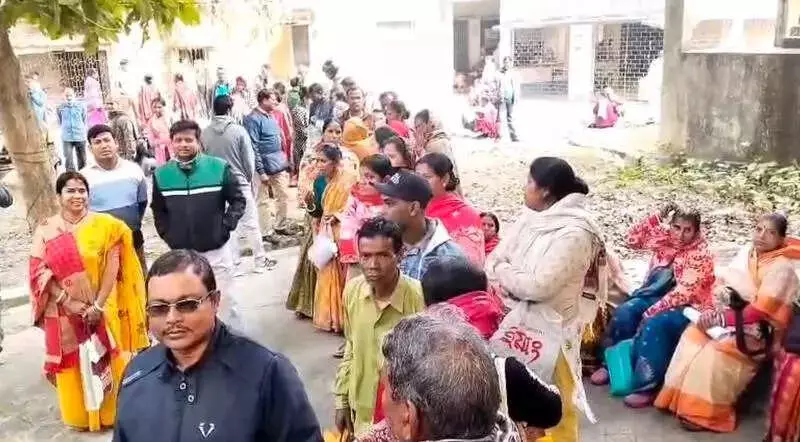
Special Intensive Revision (SIR) hearings for voter lists commenced in West Bengal's politically significant Matua heartland this Sunday, drawing large crowds fraught with anxiety. The process, critical for updating electoral rolls, saw scores of community members—many lacking the necessary documentation—lining up at block offices across North 24 Parganas district.
Long Queues and Empty Hands: The Scene on the Ground
The second day of hearings unfolded with palpable tension. While some individuals held their Electors Photo Identity Cards (EPICs), Aadhaar cards, or land documents, many others arrived with empty hands. A common thread of uncertainty, particularly among those not listed in the 2002 electoral roll, was evident. The scenes were replicated in several areas, most prominently in the Bongaon subdivision, including Bagdah, Gaighata, Thakurnagar, and Habra.
Administrative sources indicate that over 1 lakh voters from the Matua heartland, spanning four assembly constituencies in Bongaon, are likely to receive hearing notices. A significant issue identified is the lack of progeny mapping. Many current voters, predominantly those who migrated from Bangladesh, find their names on the 2025 or even the 2002 list, but the names of their parents or grandparents are absent from historical rolls.

Personal Stories of Migration and Fear
The personal narratives highlight the deep-seated fears. Subodh Mondal, who migrated from Satkhira in Bangladesh in 1993, came to the Gaighata hearing with his voter card, Aadhaar, and land papers. Despite this, he remains anxious. "I applied at a CAA camp and received an SMS, but I have not yet received the citizenship certificate," Mondal said. "I am extremely anxious about whether my name or those of my family members will be included in the final list. If excluded, I don't know what kind of citizenship-related problems we may face."
In Bagdah, elderly Samir Ranjan Biswas waited in a long queue. Having fled persecution in Bangladesh's Gopalganj decades ago, his future remains unclear. "I applied under the Citizenship (Amendment) Act four months ago, but I am yet to get citizenship. I don't know whether my name will figure in the final electoral roll," he stated.
At a hearing centre in Thakurnagar, the nerve-centre of the Matua community, Rohini Das and her husband Ajit Das expressed similar doubts after presenting their land deeds and Aadhaar cards. "We still don't know whether our names will be retained," they said.
Political Crossfire Over Documents and Rights
The situation has ignited a political debate. Junior Union Minister Shantanu Thakur claimed that most Matua refugees possess at least one or two of the required documents and suggested that those without could apply under the CAA. Countering him, Trinamool Congress MP Mamata Bala Thakur questioned why Aadhaar was not made mandatory for the hearings.
She accused the Centre of attempting to strip the Matuas of their voting rights through the Election Commission, stating, "I don't know how we will be able to protect them." This political tussle underscores the high stakes of the voter list revision in a region where the Matua community holds considerable electoral influence.
The hearings continue under a cloud of apprehension, with the community's citizenship status and fundamental voting rights hanging in the balance. The outcome of this Special Intensive Revision is poised to have significant repercussions for the political landscape of Bengal.






