

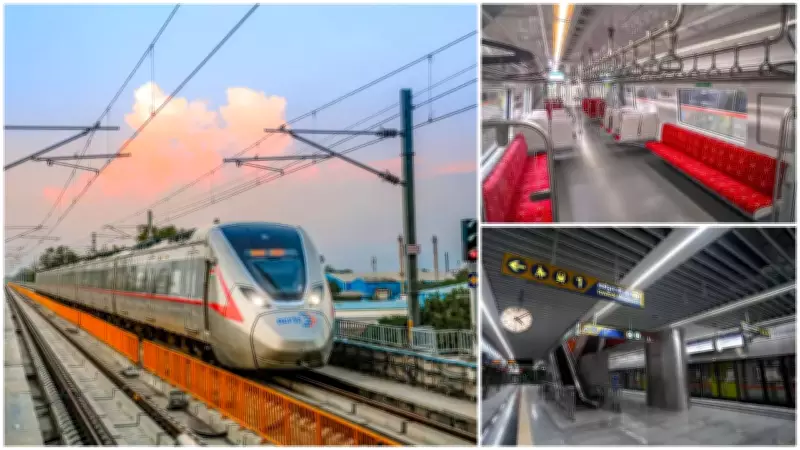
Delhi-Meerut RRTS Inaugurated: Revolutionizing Commute with Under-One-Hour Travel
Prime Minister Narendra Modi has inaugurated the complete 82-kilometer Delhi-Meerut Regional Rapid Transit System (RRTS) corridor, marking a transformative leap in India's urban transportation infrastructure. This first-of-its-kind system enables commuters to travel from Sarai Kale Khan in Delhi to Modipuram in Meerut in less than an hour, significantly reducing travel time compared to conventional road transport.
Unprecedented Speed and Efficiency
The Namo Bharat trains on this corridor operate at a maximum speed of 160 kilometers per hour, classifying it as a semi-high-speed service. With a design capability of 180 kmph, these trains maintain an average speed of 90 kmph, ensuring swift and reliable connectivity between the national capital and its neighboring regions.
Comprehensive Route and Station Network
Spanning 82 kilometers, the Delhi-Meerut RRTS features 16 strategically located stations:

- Sarai Kale Khan
- New Ashok Nagar
- Anand Vihar
- Sahibabad
- Ghaziabad
- Guldhar
- Duhai
- Duhai Depot Station
- Murad Nagar
- Modi Nagar South
- Modi Nagar North
- Meerut South
- Shatabdi Nagar
- Begumpul
- Modipuram
- Modipuram Depot
Remarkable Travel Time Reductions
The system dramatically cuts travel durations, with key journeys completed in under an hour:
- Sarai Kale Khan to Modipuram: 58 minutes
- Sarai Kale Khan to Begumpul: 54 minutes
- Sarai Kale Khan to Shatabdi Nagar: 50 minutes
This is a substantial improvement over road travel, which typically takes around 1.5 hours, subject to traffic conditions.
Premium Amenities and Safety Features
Each Namo Bharat train includes a premium coach with wider, reclining seats, accessible via a dedicated platform lounge. Additionally, one coach per train is reserved exclusively for women passengers. All stations are equipped with Platform Screen Doors integrated with train doors for enhanced safety, along with push-button controls for selective door opening. The trains and stations feature advanced public announcement systems, dynamic route maps, and display systems.
Strategic Hub and Connectivity
Sarai Kale Khan station emerges as a pivotal transit interchange, seamlessly connecting with the Delhi Metro's Pink Line, Hazrat Nizamuddin railway station, Veer Haqeeqat Rai ISBT, and city bus networks. A skywalk facilitates easy movement between the Nizamuddin railway station, Namo Bharat station, and Metro station.
Infrastructure and Investment
The project, developed at a cost of Rs 30,274 crore, includes 14 kilometers in Delhi (9 km elevated, 5 km underground) and 68 kilometers in Uttar Pradesh (61 km elevated, 7 km underground). Previously, a 55-km stretch between New Ashok Nagar and Meerut South was operational, but the full corridor is now open.
Future Expansion Plans
Looking ahead, Sarai Kale Khan station is poised to become an interchange hub for three RRTS corridors under Phase I: Delhi–Panipat–Karnal, Delhi–SNB–Alwar, and Delhi–Ghaziabad–Meerut. This expansion underscores the government's commitment to enhancing regional connectivity and integrating cluster hubs with Delhi.
The inauguration of the Delhi-Meerut RRTS represents a significant milestone in India's transportation evolution, offering a fast, efficient, and comfortable travel alternative that promises to reshape daily commutes and boost economic integration in the National Capital Region.






