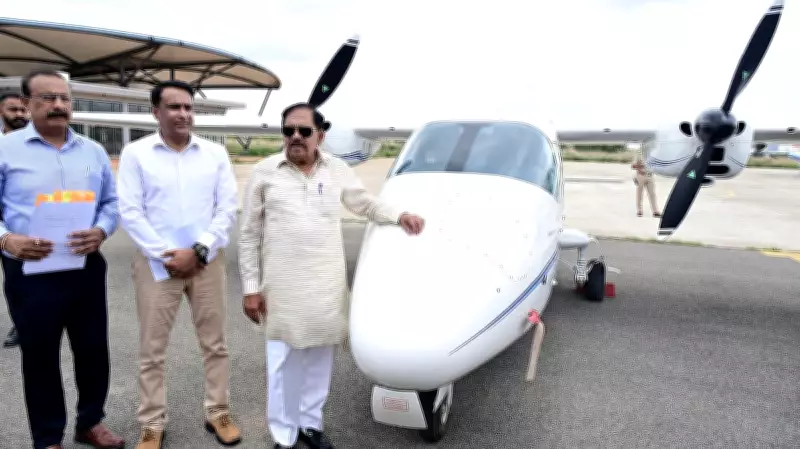
The Karnataka government has formally requested 10 acres of land adjacent to the existing Jakkur flying school to facilitate its expansion, Home Minister Dr. G. Parameshwara announced on Friday. The move aims to enhance the school's capacity to train pilots for larger aircraft.
Expansion Plans for Larger Aircraft
The proposed land extension will allow the flying school to operate four- and six-seater aircraft, a significant upgrade from its current fleet of smaller trainers. Parameshwara stated that the additional space is critical for building new hangars and runways to accommodate these larger planes.
Currently, the Jakkur flying school primarily uses two-seater aircraft for basic pilot training. The expansion is expected to attract more cadets and meet the growing demand for commercial pilots in India.

Strategic Importance of Jakkur
Located in northern Bengaluru, Jakkur flying school is one of the oldest government-run aviation training institutes in Karnataka. The school has been operating for decades and has produced several professional pilots. However, its infrastructure has not kept pace with industry requirements.
The 10-acre adjacent plot is owned by the state government but is currently underutilized. The Home Department, which oversees the flying school, has initiated the process to transfer the land for aviation purposes.
Impact on Pilot Training
India faces a shortage of trained pilots, with airlines expanding their fleets rapidly. The expansion of Jakkur flying school could help bridge this gap by increasing the number of trainees and offering advanced training on multi-engine aircraft.
Four- and six-seater aircraft are used for commercial pilot license (CPL) training and advanced instrument rating. By enabling such training, the school can provide a complete curriculum without requiring students to move to other states.
Government Commitment
Parameshwara emphasized the state's commitment to upgrading aviation infrastructure. He noted that the expansion aligns with the central government's UDAN scheme, which aims to improve regional connectivity.
The land acquisition is expected to be completed within a year, pending approvals from the revenue department and local authorities. Once operational, the expanded facility could accommodate up to 50 additional cadets per batch.