

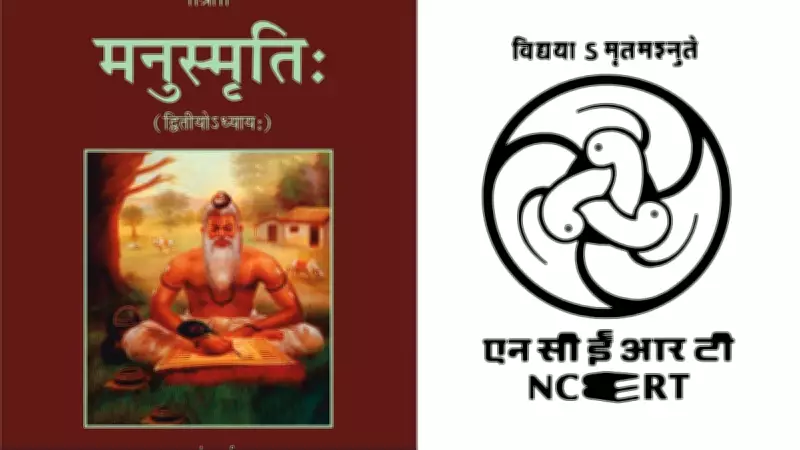
The National Council of Educational Research and Training (NCERT) has released a new Class 9 social science textbook that cites the Manusmriti while discussing the status of women in ancient India. This inclusion has sparked discussions among educators and historians about the portrayal of historical texts in school curricula.
Manusmriti Reference in Textbook
The textbook, part of the revised social science syllabus, references the Manusmriti to illustrate ancient Indian perspectives on women's roles and rights. According to the textbook, the Manusmriti is used as a source to explain the social norms and legal codes that governed women's lives in ancient times. The reference is part of a broader chapter on Indian society through the ages.
NCERT officials stated that the inclusion aims to provide students with a comprehensive understanding of historical sources. "The Manusmriti is a significant ancient legal text, and its mention helps students critically analyze historical perspectives on gender," said a NCERT spokesperson.

Emergency Section Introduced
Just a day before the Manusmriti reference came to light, the same textbook made headlines for including a section on the Emergency (1975-1977) for the first time in a Class 9 NCERT book. The chapter covers the political events leading to the Emergency, its implementation, and its impact on Indian democracy. This addition is part of NCERT's ongoing curriculum revision to include contemporary historical events.
According to education experts, the Emergency section is designed to help students understand the importance of democratic institutions. "Including the Emergency in the Class 9 syllabus is a step towards making students aware of the fragility of democracy," said Dr. Anjali Sharma, a history professor at Delhi University.
Reactions and Controversy
The Manusmriti citation has drawn mixed reactions. Some scholars argue that the text is patriarchal and should not be presented without critical context. "The Manusmriti contains passages that subordinate women, and without proper critique, it could reinforce stereotypes," said historian Dr. Ramesh Kumar. Others support the move, stating that students should engage with primary sources. "It is important for students to read original texts and understand their historical context," said Dr. Meera Iyer, a curriculum specialist.
NCERT clarified that the textbook includes the Manusmriti as one of several sources, alongside other texts that present diverse views on women's status. The chapter also discusses the role of women in the Vedic period and later eras, highlighting both progressive and restrictive elements.
Broader Curriculum Revisions
The new Class 9 textbook is part of a larger NCERT effort to update social science materials. The revisions aim to align with the National Education Policy 2020, which emphasizes critical thinking and multidisciplinary learning. Other changes include updated chapters on the Indian Constitution, economic development, and social justice.
NCERT has faced scrutiny in the past for textbook content, with debates over historical accuracy and ideological bias. The current revisions have been undertaken by a committee of experts, including historians, sociologists, and educationists.






