

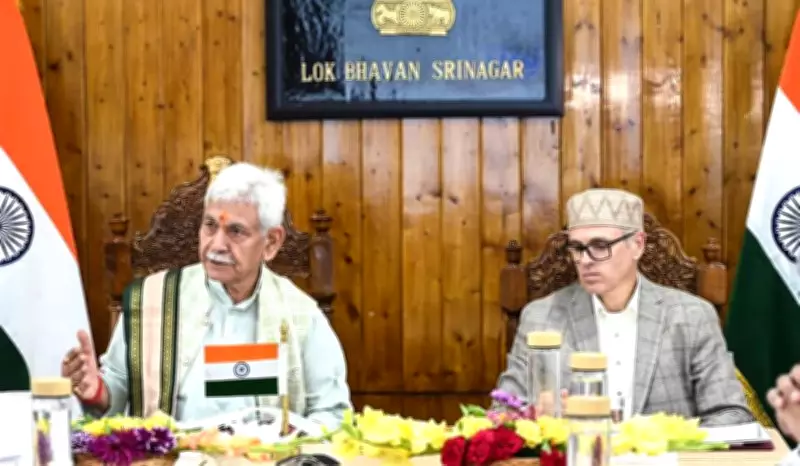
The 36th University Council meeting of Sher-e-Kashmir University of Agricultural Sciences and Technology of Kashmir (SKUAST-K) was chaired by Jammu and Kashmir Lieutenant Governor Manoj Sinha at Raj Bhavan in Srinagar on Wednesday. Chief Minister Omar Abdullah was also present at the meeting.
Key Reforms Approved
Officials confirmed that the Council approved several institutional reforms. These include the upgrade of the Agricultural Research Information System into a Directorate of Information Technology, the transformation of the Internal Quality Assurance Cell into a Directorate of Quality Assurance, and the establishment of an International Students Cell to strengthen global outreach and student support services.
Three Futuristic Flagship Initiatives
As part of the university’s future roadmap, three self-sustaining flagship initiatives were proposed. The first is a Centre for Agri Innovation, Analytics and Certification, intended to serve as a National Reference Laboratory. The second is an Agri-Startup Park designed to nurture and host more than 50 SKUAST-led startups. The third is a Global Veterinary School, envisioned as an internationally benchmarked centre for veterinary education, research and advanced clinical services.

L-G’s Commendation and Directives
Lieutenant Governor Sinha commended the university’s progress in academics, research, innovation, entrepreneurship and international collaborations. He noted that SKUAST-Kashmir’s transformative initiatives could position it among the country’s leading innovation-driven and globally engaged agricultural universities. Sinha also directed the Vice Chancellor to ensure that University Council meetings are held at least twice a year for timely review of academic and administrative matters.
Vice Chancellor’s Report
Presenting the University Report, Vice Chancellor Prof Nazir Ahmad Ganai highlighted SKUAST-Kashmir’s transformation from a regionally focused institution into a nationally recognised university with a vision of becoming a globally competitive centre of excellence in agricultural and allied sciences. He outlined the university’s commitment to education, research, innovation and societal impact.
The Vice Chancellor informed the Council that the university has achieved significant gains in national rankings, developed the largest startup ecosystem among higher educational institutions in Jammu and Kashmir, and secured 123 Intellectual Property Rights, including patents, trademarks and designs, reflecting a strong culture of innovation and translational research. He added that nearly 30 per cent of the university’s students now come from outside Jammu and Kashmir, underscoring its growing national outreach and academic reputation.






