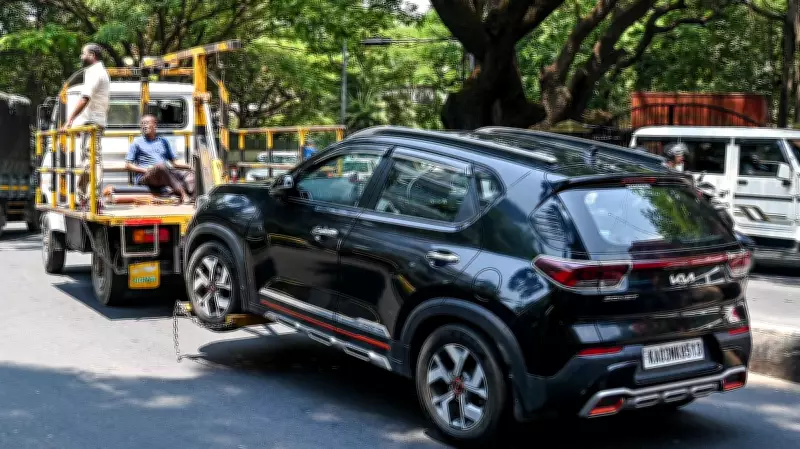
The Karnataka government's decision to sharply increase towing fines for vehicles parked illegally in Bengaluru has drawn widespread criticism from motorists, who describe the new charges as an excessive financial strain on middle-class families. Many commuters have called for an immediate revision of the towing fees, arguing that the penalty is disproportionate to the offense.
New towing charges spark outrage
Under the revised rates, the towing fine for two-wheelers has been raised from Rs 500 to Rs 1,500, while for four-wheelers it has jumped from Rs 1,000 to Rs 5,000. The hike, implemented from July 1, 2026, is part of the government's efforts to improve road safety and reduce traffic congestion in the city. However, motorists claim the increase is too steep and lacks justification.
According to a commuter who spoke to the media, the new fines are a burden on daily wage earners and middle-income groups. They said, 'The government should consider the financial situation of ordinary people before imposing such high penalties.' Another motorist noted that the fine for minor parking violations should not exceed the cost of a day's earnings for many workers.

Government defends the move
Karnataka Transport Department officials have defended the hike, stating that it is necessary to deter illegal parking, which is a major cause of traffic jams and accidents in Bengaluru. A senior official said, 'The increased fines are aimed at ensuring compliance with traffic rules and making the roads safer for everyone. We have seen a significant reduction in illegal parking in areas where the new rates are being enforced.'
The government also pointed out that the revised fines are in line with those in other major Indian cities like Mumbai and Delhi, where towing charges for four-wheelers range from Rs 4,000 to Rs 6,000. However, motorists argue that Bengaluru's traffic conditions and income levels are different, making the comparison invalid.
Impact on middle-class families
Many commuters expressed concern that the steep hike would particularly affect those who rely on two-wheelers for daily commute. A software professional from Whitefield said, 'I earn a modest salary, and a Rs 1,500 fine for parking my scooter in a no-parking zone by mistake is too much. It affects my monthly budget.'
Auto-rickshaw drivers and delivery personnel, who often park temporarily near commercial areas, also voiced their frustration. One delivery executive stated that he now has to spend a significant portion of his daily earnings on parking fees or risk heavy fines. He said, 'The government should create more parking spaces rather than just increasing fines.'
Demand for revision and alternatives
Several motorists have started an online petition urging the state government to revise the towing charges downward. The petition, which has garnered over 10,000 signatures, proposes a graded fine system based on the duration of parking violation and the type of vehicle. It also suggests increasing the number of designated parking areas in the city.
Traffic experts have also weighed in, recommending that the government focus on improving public transport and parking infrastructure rather than relying solely on punitive measures. Dr. Ramesh Kumar, a transport analyst, said, 'While fines can deter violations, they should be complemented with better urban planning to address the root causes of illegal parking.'
Conclusion
The steep hike in towing fines has clearly irked Bengaluru's motorists, who feel the government has overlooked the financial impact on ordinary citizens. As the debate continues, the onus is on the authorities to balance road safety goals with the economic realities of the people. Whether the government will reconsider the fines remains to be seen, but the growing public outcry suggests that a revision may be inevitable.