The National Testing Agency (NTA) has implemented extensive security measures for the NEET-UG re-examination scheduled on June 21, following the controversy over alleged paper leaks in the original test. The agency has enlisted the Indian Air Force (IAF) to transport question papers, deployed over 51,000 jammers, and installed more than 13,500 CCTV cameras monitored by AI tools. The NTA stated that the examination will be held in over 95,000 rooms across 5,440 centres, with comprehensive arrangements to ensure fairness and security.
IAF Transport and Security Arrangements
One of the most significant measures is the deployment of the Indian Air Force to airlift sealed question paper packets. Since June 13, IAF transport aircraft and Mi-17 helicopters have conducted nearly 200 sorties to deliver question papers to 18 designated distribution zones across the country. From these hubs, the papers are transported to examination centres under police escort and strict security protocols. Officials said this ensures foolproof and time-bound delivery, minimizing the risk of disruption or tampering.
Technology and Surveillance
The NTA has installed 13,560 CCTV cameras across examination centres, with feeds monitored at national, state, and ministry levels. For the first time, AI-powered tools will analyze live CCTV footage to detect suspicious activity and flag anomalies in real time. Additionally, 51,311 jammers have been deployed—17,054 by ECIL and 34,257 by BEL—to block unauthorized electronic communication during the test. Candidate verification has been strengthened with 38,795 frisking staff and 48,448 personnel for biometric verification, including fingerprint scanning and facial recognition.

Personnel and Monitoring
Each of the 95,000 examination rooms will have two invigilators, and every centre is staffed with more than ten additional examination functionaries. Around 6,700 observers and over 100 virtual observers will monitor the examination, supported by AI-based tools. A Centre Systems Officer has been deployed at each of the 5,440 centres to monitor CCTV feeds and address technical issues. The NTA also conducted a nationwide mock drill on June 20 to test all security systems, including CCTV cameras, jammers, frisking procedures, and biometric verification.
Police Deployment and Anti-Cheating Measures
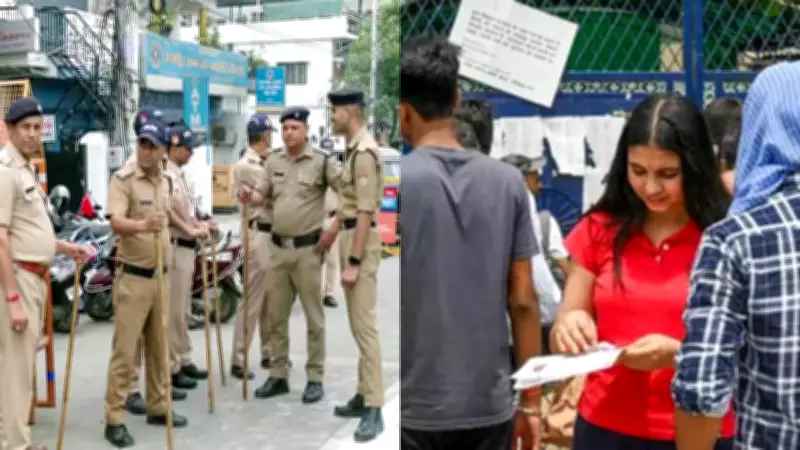
Police forces, intelligence agencies, cyber units, and paramilitary personnel have been mobilized to secure examination centres. In Uttar Pradesh, a three-tier security arrangement has been put in place. Joint Commissioner of Police (Law and Order) Babloo Kumar said, "The police deployment is structured into three tiers. The first team will be responsible for safely transporting the question papers to the centers and bringing back the answer sheets. The second team has been deployed to handle the checking and frisking of candidates and teachers using HHMDs. The third tier will manage law and order and security on the outer premises." In Ahmedabad, police will deploy drone surveillance and Quick Response Teams around examination centres. DCP Reema Munshi said, "The Crime Branch is deploying a Quick Response Team (QRT) and conducting drone surveillance. The Cyber Crime Branch will monitor social media to prevent any negative content from causing panic." Jharkhand has equipped all 67 examination centres with CCTV cameras and mobile signal jammers, while Rajasthan has activated technical surveillance systems and social media monitoring.
Restrictions and Candidate Welfare
In Ranchi, prohibitory orders under Section 163 of the BNSS will be enforced within a 200-metre radius of examination centres. Similar restrictions have been imposed in Dehradun, where police escorts will accompany question paper transportation. The government has also announced candidate welfare measures, including cooling zones with seating, drinking water, ORS, and first-aid facilities at examination centres in Delhi. Chief Minister Rekha Gupta said the government was working to provide a comfortable and stress-free environment for students. Candidates will be allowed free travel on DTC buses upon presentation of their admit cards. In Karnataka's Davanagere district, doctors will be stationed at examination centres, while officials have ensured adequate lighting, toilet facilities, and dedicated safety rooms.