

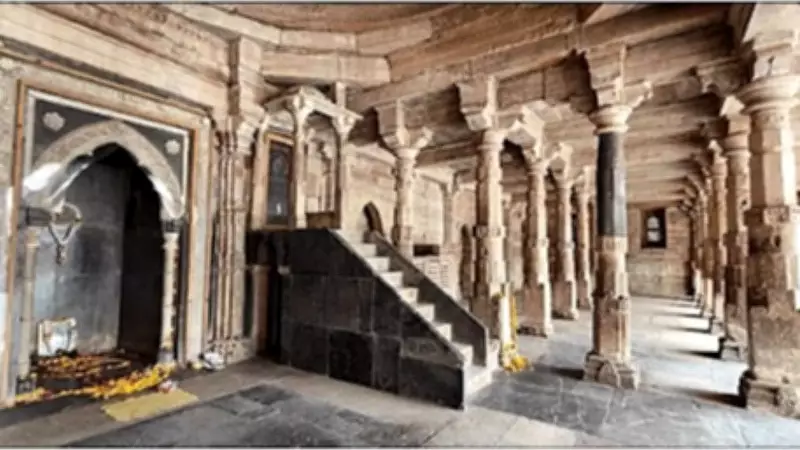
The Archaeological Survey of India (ASI) on Tuesday informed the Indore bench of the Madhya Pradesh High Court that the existing structure of the Bhojshala-Kamal Maula Mosque complex in Dhar was constructed using architectural members, pillars, and sculptural fragments belonging to temples of the Parmar era. The ASI stated that figures of deities were mutilated before being reused in the construction.
Submission in Court
Additional Solicitor General Sunil Kumar Jain made these submissions before the bench comprising Justice Vijay Kumar Shukla and Justice Alok Awasthi. He referred to a court-ordered 98-day scientific investigation, survey, and excavation carried out in 2024.
Survey Details
The survey was led by ASI Additional Director General Prof Alok Tripathi and conducted by a core technical team of archaeologists, epigraphists, chemists, draughtsmen, surveyors, photographers, and conservators.

Jain concluded his arguments by submitting that a large structure associated with literary and educational activities existed at the site during the Parmar period. The site passed through three architectural phases, and the existing structure was built from parts of earlier temples.
Three Architectural Phases
The ASI identified three distinct architectural phases. The oldest consists of brick structures built on natural soil, dated to the Parmar period (10th to 11th century CE). In the second phase, these structures were enlarged using basalt stone and embellished with numerous inscriptions. One inscription references 'Sharada Sadan' from the Parijatamanjari, a text later fixed into the present structure. The third and most recent phase — the existing structure — was built over this basalt platform using limestone. The ASI report states it 'appears to have been made hurriedly', with little attention to symmetry or design.
Pillars and Deity Figures
The structure features long colonnades on all four sides, supported by 106 pillars and 82 pilasters — all originally part of temples. Figures of deities including Ganesh, Brahma, Narasimha, and Bhairava, along with human and animal carvings, were mutilated before incorporation into the existing structure. Large Sanskrit and Prakrit inscriptions were similarly defaced, their surfaces chiselled away so the stone slabs could be reused as flooring or wall veneer.
Mihrab and Inscriptions
The mihrab in the western colonnade, the ASI noted, is a new construction made of different material, its walls abutting directly against the earlier basalt platform. More than 150 Sanskrit and Prakrit inscriptions in Nagari script, datable to the 13th century CE, were found at the complex. Several of these inscriptions are linked to Parmar kings, including Maharajadhiraja Bhojadeva.
Arabic and Persian Inscriptions
The ASI also examined 56 Arabic and Persian inscriptions, observing that all Sanskrit and Prakrit inscriptions pre-date the Arabic and Persian ones — 'indicating that users or engravers of the Sanskrit and Prakrit inscriptions occupied the place earlier'.
Historical Records
The ASI further cited an inscription of Khilji king Mahmud Shah, dated 1455 CE, which records that he 'destroyed the effigies of idols, made this temple into a mosque violently'. Thirty-one coins were also recovered, the earliest one dating to the Parmar era.






