Rajasthan is confronting a severe challenge in its fight against cybercrime, where a shocking gap between registered cases and court convictions highlights systemic failures. Despite a sharp rise in incidents involving obscene audio-video content and online blackmail, the state's justice delivery mechanism appears to be struggling to keep pace.
A Stark Picture of Low Conviction Rates
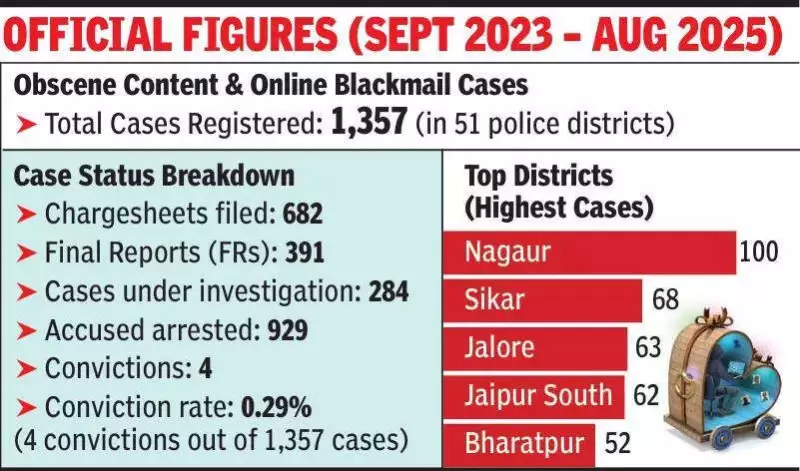
Official data presented in the state assembly reveals a dismally low conviction rate for cyber offences. Between September 1, 2023, and August 31, 2025, police registered a total of 1,357 cases under relevant laws. However, in a statistic that has alarmed lawmakers and experts alike, only four individuals were convicted in courts during this two-year period.
The figures were shared by the state government in response to a question raised by Kishanpole legislator Amin Kagzi. The data breakdown shows that out of the total cases, police filed charge-sheets in 682 instances and submitted final reports (FRs) in 391 cases. Meanwhile, 284 cases remain under investigation. Authorities arrested 929 accused persons in connection with these crimes.

Regional Variations and Government Response
The incidence of registered cybercrime varied widely across Rajasthan's districts. Nagaur district recorded the highest number at 100 cases, followed by Sikar (68), Jalore (63), Jaipur South (62), and Bharatpur (52). On the opposite end of the spectrum, Kota Rural registered merely two cases, and Dungarpur saw three cases in the same period.
In its reply, the state government outlined measures taken for cybercrime prevention. These include regular directives issued by the Home Department and Police Headquarters. A key step has been the establishment of dedicated cyber police stations in every district, each led by a nodal officer of Deputy Superintendent of Police (DSP) rank. The government stated that details concerning staffing, budgets, and functioning have been provided separately.
Systemic Failure and Expert Warnings
Reacting strongly to the data, MLA Amin Kagzi termed it a reflection of a systemic collapse. "Merely registering cases is insufficient. When only four convictions result from 1,357 cases, it indicates a complete breakdown in investigation and prosecution," Kagzi said. He emphasized that victims, particularly women, are being denied justice, allowing cyber criminals to operate fearlessly. He demanded urgent steps to strengthen forensic capabilities, cyber investigation skills, and prosecutorial follow-up.
Deputy Inspector General (Cybercrime) Vikas Sharma acknowledged the issue, stating, "We are working hard to ensure an increase in convictions."
Legal and cyber experts echo the concerns, warning that without urgent reforms, the problem will worsen. Cybercrime expert Mukesh Choudhary pointed to several root causes: "Low conviction rates stem from weak digital evidence preservation, delayed cyber forensic analysis, and a lack of specialized training for investigators." He explained that cases often fall apart due to improper seizure of devices, loss of critical metadata and IP address trails, and the failure to technically establish a clear link between the accused and the online activity. "Without expedited cyber investigations, real-time cooperation from digital platforms, and dedicated cyber prosecutors, arrests alone will never translate into convictions," Choudhary added.
The consensus is clear: for Rajasthan to effectively combat the surge in cybercrime, it must bridge the critical gaps in its investigative and judicial processes, ensuring that arrests lead to successful prosecutions and justice for victims.