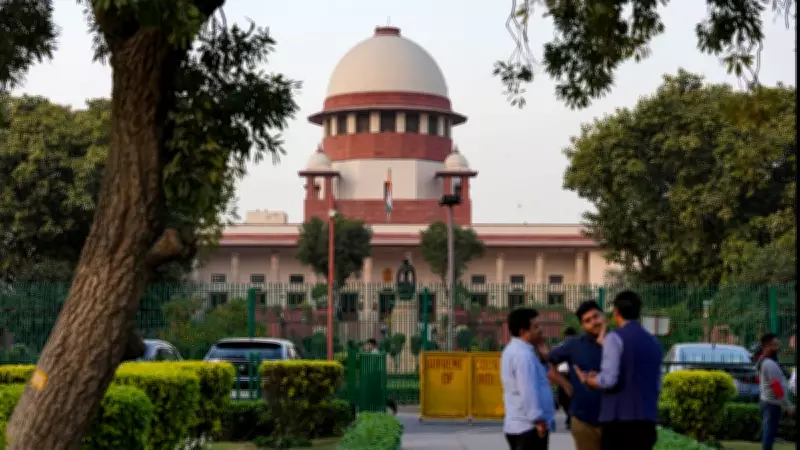
The Supreme Court of India on Thursday issued a landmark directive prohibiting the dissemination of court proceedings on social media platforms without explicit prior authorization from the court. The order, passed by a three-judge bench led by Chief Justice of India, aims to curb the misuse of judicial content and ensure that only accurate and authorized information reaches the public.
Key Provisions of the Ban
Under the new rules, any person, media outlet, or social media user must obtain written permission from the Supreme Court registry before posting videos, transcripts, or summaries of court hearings. The directive applies to all platforms including Facebook, Twitter, YouTube, and Instagram. Violations will be treated as contempt of court, punishable by fine or imprisonment.
"The unfettered circulation of court proceedings on social media has led to distortion of facts and unwarranted commentary, which undermines public trust in the judiciary," Chief Justice D.Y. Chandrachud stated in the order. "This step is essential to preserve the sanctity of our judicial institutions."

Scope and Implementation
The ban covers live streaming, recorded clips, and even textual summaries that are not officially sanctioned. However, journalists covering court proceedings for news reports are exempt, provided they adhere to reporting guidelines. The court has also directed social media platforms to remove any unauthorized content within 24 hours of notification.
According to the Supreme Court's Registry, over 200 cases of unauthorized social media posts related to high-profile hearings were reported in the past year alone, leading to this comprehensive action. "We found that many posts contained misleading interpretations or edited clips that changed the context," said an official.
Reactions and Criticism
The decision has drawn mixed reactions. While some legal experts argue it enhances judicial dignity, others view it as a curb on transparency. Senior advocate Indira Jaising called the ban "regressive" and said it could hinder public access to justice. "The court should instead focus on educating citizens about proper reporting rather than imposing blanket restrictions," she said.
On the other hand, the government has welcomed the move. Law Minister Kiren Rijiju said, "This will prevent the weaponization of judicial proceedings for political or sensational purposes."
International Context
India's Supreme Court joins a growing list of jurisdictions that regulate social media coverage of court proceedings. In the United Kingdom, the Contempt of Court Act restricts live tweeting from courtrooms, while in Singapore, recording and posting court proceedings is banned entirely. The Indian order goes further by requiring prior permission even for simple sharing of already uploaded content.
Implementation Challenges
Enforcement remains a challenge given the volume of social media activity. The court has directed the Cyber Cell of the Delhi Police to monitor compliance. Additionally, the Bar Council of India has been asked to issue guidelines for lawyers regarding social media conduct during trials.
"We recognize the practical difficulties, but this is a necessary deterrent," the Chief Justice noted. "The responsibility also lies with platforms to ensure compliance through automated detection tools."
The order takes immediate effect, and existing unauthorized posts must be removed within 48 hours. Non-compliant individuals or entities will face contempt proceedings.
Impact on Public Discourse
The ban is likely to reduce the real-time dissemination of court arguments, which has become a staple for legal commentators and news outlets. However, the court emphasized that official transcripts and summaries will continue to be available on the Supreme Court website. "This is not about secrecy; it's about authenticity," the order stated.
In a related development, the court has also established a committee to explore the possibility of an official social media channel for the Supreme Court that would provide verified content.