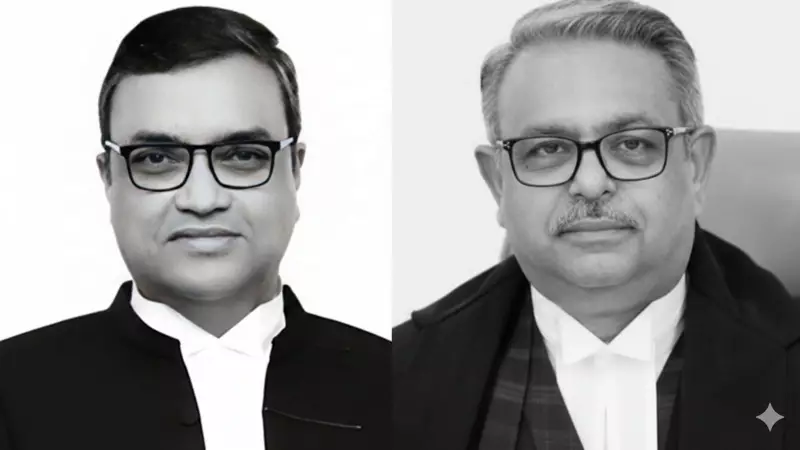
In a significant ruling that clarifies the foundational principle of merit in public employment, the Supreme Court of India has stated that posts advertised as "general," "open," or "unreserved" constitute a pool available to all candidates based on merit and are not a quota for any specific social group. The judgment, delivered on December 19, 2025, by a bench comprising Justices Dipankar Datta and Augustine George Masih, came on an appeal against a Rajasthan High Court verdict concerning the recruitment of clerical staff.
The Core of the Judgment: Merit Overrules Social Classification
The apex court emphatically rejected the notion that the general category is an exclusive compartment for candidates from non-reserved backgrounds. The bench relied on its own precedents to underline that vacancies notified as open are not reserved for any caste, tribe, class, or gender. The court held that treating these posts as such would violate the constitutional guarantee of equality under Articles 14 and 16.
"The placement of a more meritorious reserved category candidate in the open category is not a facet of reservation, but a principle of equality founded on merit," the court observed. It added that excluding candidates solely because of their social category would amount to impermissible discrimination.

Background: The Rajasthan Recruitment Dispute
The case stemmed from a recruitment process initiated in August 2022 for 2,756 posts of Junior Judicial Assistant/Clerk Grade-II in the Rajasthan High Court, district courts, and allied institutions. The selection involved a written exam followed by a typewriting test.
A contentious issue arose when the results were declared in May 2023. The cut-off marks for several reserved categories—including Scheduled Castes (SC), Other Backward Classes (Non-Creamy Layer), Most Backward Class (Non-Creamy Layer), and Economically Weaker Sections (EWS)—were found to be higher than the cut-off for the general category.
Consequently, many reserved category candidates who scored more than the general cut-off but less than their category's specific cut-off were excluded from the shortlist for the typewriting test. They successfully argued before the Rajasthan High Court that this was unfair, as they were more meritorious than many general category candidates but were confined to their reserved slots.
Dismissing the "Double Benefit" Argument
The administration of the Rajasthan High Court, which appealed to the Supreme Court, contended that adjusting meritorious reserved candidates into the general pool should only happen at the final selection stage, not during intermediate shortlisting. They argued that this would grant candidates a "double benefit."
The Supreme Court bench firmly rejected this argument. It clarified that when a reserved category candidate qualifies for an open post purely on merit, without availing any relaxation, they are not drawing upon reservation benefits at that stage. "The apprehension of a 'double benefit' is misconceived," the court stated, pointing out that such merit-based selection does not reduce the quota meant for reserved categories.
The court upheld the High Court's direction to rework the merit lists, stating that the recruiting authority's action in not treating these meritorious candidates as general category candidates was illegal. "The candidates paid a price for their merit," the bench noted.
This judgment reinforces the principle that merit in open competition is sacrosanct. It underscores that the general category is a true open field, and social classification cannot be a barrier for a candidate who has outperformed others on a level playing field. The ruling provides crucial clarity for future public recruitment drives across India, ensuring that meritocracy and constitutional equality are upheld in letter and spirit.