

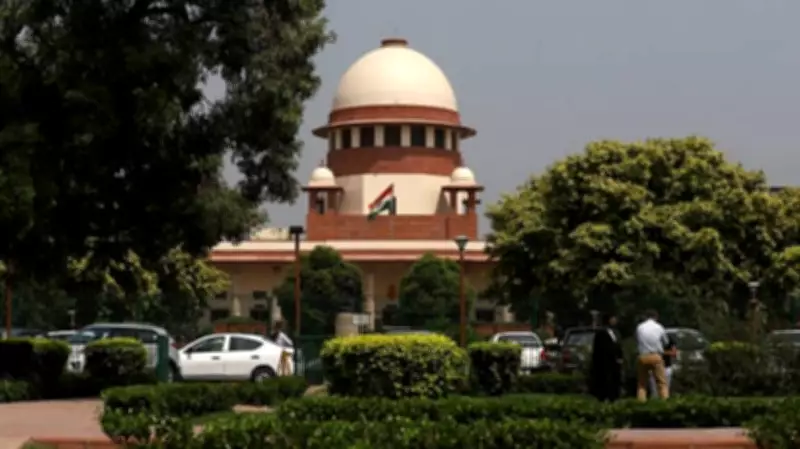
The Supreme Court of India has ruled that private medical colleges cannot be compelled to charge fees equivalent to government institutions. The judgment, delivered on 24 June 2026, also upheld the Rs 8 lakh annual income limit for the Economically Weaker Sections (EWS) category, a key criterion for reservation in medical admissions.
Court's Stance on Fee Regulation
A bench comprising Justices Ashok Bhushan and R. Subhash Reddy clarified that while the state can regulate fees to prevent profiteering, it cannot force private colleges to adopt the fee structure of government colleges. The court emphasized that private institutions have the autonomy to determine their fees, subject to reasonable regulation.
"Private medical colleges cannot be forced to charge government fees," the bench stated, adding that the fixation of fees must balance affordability for students and the operational viability of institutions.

EWS Income Limit Upheld
The court also upheld the Rs 8 lakh annual income ceiling for EWS reservation, rejecting petitions that sought to raise or remove the cap. The bench noted that the limit is a reasonable classification to identify economically weaker sections and does not violate the right to equality.
"The income limit of Rs 8 lakh is not arbitrary," the court observed, citing that it aligns with similar thresholds used for other welfare schemes. The judgment provides clarity on the EWS quota, which reserves 10% of seats in educational institutions and government jobs for economically disadvantaged groups.
Scholarships as a Solution
Addressing concerns about affordability, the Supreme Court suggested that the government explore scholarship schemes for meritorious students from low-income families who cannot afford private college fees. "Scholarships can be a viable mechanism to ensure access without imposing an undue burden on private institutions," the bench remarked.
The court directed the central and state governments to consider creating a fund or expanding existing scholarship programs to support students from economically weaker backgrounds pursuing medical education in private colleges.
Impact on Medical Admissions
The ruling is expected to impact the ongoing admission process for the 2026-27 academic year. Private medical colleges, which often charge significantly higher fees than government institutions, will now have clearer legal backing for their fee structures. However, students from EWS backgrounds may face challenges unless scholarship mechanisms are implemented swiftly.
According to data from the Ministry of Health and Family Welfare, there are over 300 private medical colleges in India, accounting for nearly 60% of total MBBS seats. The average annual fee in private colleges ranges from Rs 10 lakh to Rs 25 lakh, compared to Rs 1-2 lakh in government colleges.
Reactions and Next Steps
Legal experts and stakeholders have responded with mixed reactions. While private college associations welcomed the judgment, student groups expressed concerns about affordability. The court has asked the government to submit a report within three months on the feasibility of a scholarship framework.
"This is a balanced judgment that protects the interests of both private institutions and students," said Dr. R. S. Sharma, secretary of the Association of Private Medical Colleges. Meanwhile, activist and lawyer Prashant Bhushan argued that the court should have mandated a more affordable fee structure for EWS students.
The Supreme Court's decision sets a precedent for fee regulation in private professional colleges across the country, reinforcing the principle of institutional autonomy while leaving room for government intervention to ensure equitable access.






