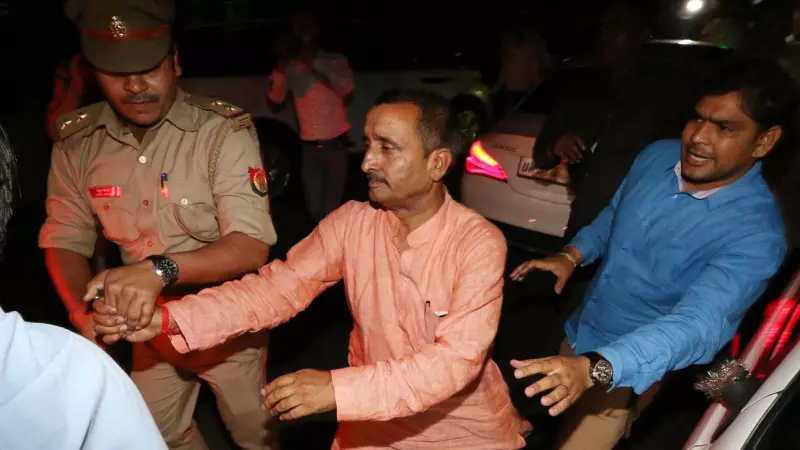
In a significant development on December 29, 2025, the Supreme Court of India intervened to stay the bail granted to former Uttar Pradesh MLA Kuldeep Singh Sengar by the Delhi High Court. Sengar is an accused in a case under the Protection of Children from Sexual Offences (POCSO) Act, 2012. The apex court bench observed that substantial questions of law were involved, necessitating its consideration, thereby expressing clear judicial discomfort with the High Court's interpretation.
The Core Legal Debate: Who is a 'Public Servant'?
The Delhi High Court's decision to grant bail relied heavily on a 1984 Supreme Court precedent, R S Nayak v. A R Antulay. That ruling stated that a Member of the Legislative Assembly (MLA) is not a "public servant" under the specific definition in Section 21(12)(a) of the Indian Penal Code (IPC). However, legal experts argue this is a mechanical and flawed application to the POCSO Act.
The IPC definition uses disjunctive phrasing, including anyone performing a "public duty". The Prevention of Corruption Act, 1988, defines "public duty" as a duty in which "the State, the public or the community at large has an interest." By this constitutional measure, the functions of an MLA or MP—representing their constituency and shaping public life—undeniably constitute a public duty. Their influence is structural and profound, creating a high potential for misuse against vulnerable victims, which is precisely the abuse POCSO seeks to punish more severely.

Purposive Interpretation: The Spirit of POCSO
POCSO is not an ordinary penal statute; it is a purposive, child-protective law. Its objective, particularly under Section 5(c), is to recognise and impose enhanced punishment for aggravated forms of sexual abuse where the offender abuses a position of power, authority, or trust. The designation of "public servant" is key to this aggravation.
The aggravation stems not from a formal government employment contract but from the capacity to intimidate, silence, or manipulate systems—a capacity legislators possess in abundance. Excluding them based on a narrow, status-based interpretation from a 1984 corruption case hollows out the law's intent. The Supreme Court itself, in the 2021 Attorney General of India v. Satish case (the skin-to-skin verdict), warned against literalism that defeats a statute's protective purpose.
Why a Modern Reading is Essential
Recent jurisprudence supports a dynamic interpretation. In Aman Bhatia v. State (NCT of Delhi) (2025), the Supreme Court held that stamp vendors are "public servants" under the Prevention of Corruption Act, 1988. The Court emphasized that modern accountability statutes focus on the nature of the duty performed, not traditional official status. If a stamp vendor falls under this category, it is normatively incoherent to exclude an elected representative wielding far greater authority over public life and vulnerable communities.
The question is not about overturning the Antulay judgment but about assessing its applicability to a 2012 child-protection law designed for a different social and constitutional context. Statutory interpretation cannot be frozen in time.
The Supreme Court's stay on bail for Kuldeep Singh Sengar has rightly reopened this critical debate. For POCSO to fulfill its mandate as a robust safeguard for children, the term "public servant" under Section 5(c) must be interpreted expansively to include legislators. Failure to do so risks allowing the law to become a shield for the powerful rather than a sword for justice, undermining the very children it was enacted to protect. The writer, Shashank Maheshwari, teaches at Jindal Global Law School.