The Special Investigation Team (SIT) probing alleged irregularities in Ram Temple donations has intensified its investigation, examining 24 individuals and reconstructing the entire fund flow—from collection at donation boxes to final bank deposits—while scanning CCTV footage and financial records.
Sources said the SIT has reviewed footage from the counting centre and scrutinised documents related to nearly 40 donation boxes across the temple complex. Of those questioned so far, 12 are linked to the Shri Ram Janmabhoomi Teerth Kshetra Trust, six to the State Bank of India (SBI), and six to Tata Consultancy Services (TCS), which manages the trust’s digital systems.
Investigators have also visited the SBI branch handling the trust’s account, quizzing both current and former branch managers on cash handling, verification protocols and audit trails. The probe, officials said, is focusing on possible procedural lapses in deposit and reconciliation processes.

Fifth Day of Ayodhya Probe
On the fifth day of the Ayodhya probe, the SIT separately questioned trust general secretary Champat Rai, trustee Anil Mishra and construction in-charge Gopal Rao. A preliminary report is expected to be submitted to chief minister Yogi Adityanath by June 20 after completion of the first phase, sources said.
Particular focus has been on trustee Anil Mishra, who oversees the donation management system, including storage, counting and utilisation of funds. Operating from an office adjoining the counting hall, he was questioned for nearly four hours on protocols, custody mechanisms, banking procedures and the roles of individuals including Anukalp Mishra and Lavkush Mishra, whose names have surfaced during the probe.
Counting Process Under Scrutiny
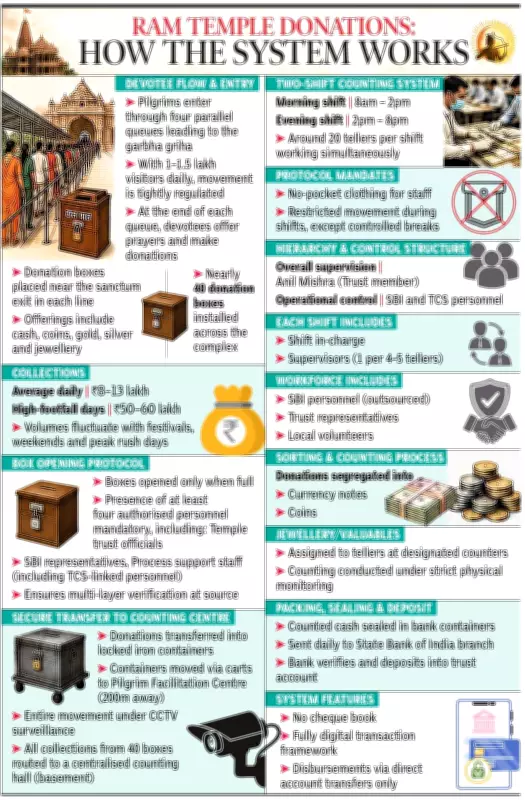
Officials familiar with the system said the counting process is supervised by a retired banking professional under Mishra’s overall oversight. Each shift has designated in-charges, with supervisors monitoring teams of four to five tellers. The workforce comprises outsourced SBI staff, trust employees and individuals linked to local RSS units.
The SIT has reconstructed the standard operating procedure: donation boxes are opened only in the presence of at least four authorised persons, including trust representatives and SBI officials. Collections are transferred into locked iron containers and transported under CCTV surveillance to the counting centre.
At the facility, currency notes, coins and valuables such as jewellery are segregated and assigned to tellers at designated counters. Personnel involved in counting are not allowed to leave during shifts except for brief, regulated breaks. After counting, cash is sealed in bank containers and transported daily to the SBI branch for verification and deposit.
Officials added that the trust’s donation account operates without cheque-book facilities, with all disbursals made through digital transfers to ensure traceability.
Five Individuals Under Scanner
So far, five individuals—Lavkush, Avnish, Anukalp, Karune and Ramshankar Yadav alias Tinnu—have come under the scanner in the alleged donation theft case. The SIT is examining their precise roles and whether any breach of protocol enabled misappropriation.
Pilgrim Facilitation Centre at Core of Donation Row
The Pilgrim Facilitation Centre, located around 200 metres from the Ram Temple in Ayodhya, has emerged as the focal point of the controversy. The facility houses a basement counting hall where collections from around 40 donation boxes across the complex are processed.
With daily footfall of around 1-1.5 lakh devotees, counting is conducted in two shifts—8am to 2pm and 2pm to 8pm—by about 20 tellers per shift. Daily collections are estimated at Rs 8–13 lakh, though inflows can spike significantly. “On some days, donations rise to Rs 50–60 lakh,” officials said.
The scale of cash handling and the centralised counting system are now under scrutiny as the SIT examines possible gaps in oversight and control.