

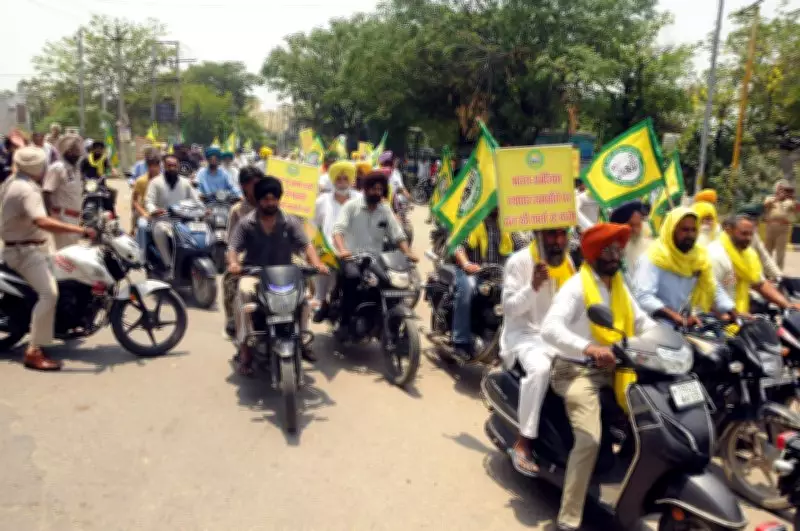
Farmers hold flag march against proposed India-US trade deal
Members of the Bharatiya Kisan Union (Ekta-Ugrahan) on Friday took out a flag march at Ranjit Avenue in Amritsar to protest against the proposed India-US free trade agreement, rising prices of petrol, diesel and cooking gas, shortage of urea fertiliser and the increasing cost of living. The march began from Ranjit Avenue and concluded near the Deputy Commissioner’s office.
Allegations of economic crisis and corporate concessions
Addressing the gathering, Dr Parminder Singh Pandori Waraich alleged that the country was passing through a serious economic crisis and accused the Centre of imposing an additional financial burden on ordinary citizens in the name of national security and war, while extending concessions to large corporate houses. He said the soaring prices of petrol, diesel and LPG had fuelled inflation, affecting both farmers and common people. The increase in the price of diesel had significantly raised cultivation costs, further deepening the agrarian crisis for farmers already burdened with debt.
Anti-farmer policies under fire
Waraich also highlighted the shortage of urea fertiliser and criticised what he termed as anti-farmer policies, including the proposed Seeds Bill 2025, power-related reforms, attempts to weaken the rural employment guarantee scheme (MGNREGA) and the proposed free trade agreement with the United States. He alleged that such measures would adversely impact farmers and the rural economy.

Next phase of agitation announced
Announcing the next phase of the agitation, the union leaders said BKU (Ekta Ugrahan) and BKU Dakaunda would organise a massive protest at Sector 34, Chandigarh, on July 4. They said village-level meetings and flag marches were being organised across Punjab to mobilise farmers for the demonstration.
Demand for fuel price reduction
The speakers said despite a decline in international crude oil prices, the Union Government had failed to pass on the benefit to consumers by reducing fuel prices. They demanded an immediate reduction in the prices of diesel, petrol and cooking gas and urged the government to place the burden of economic challenges on large corporate houses rather than ordinary citizens.






