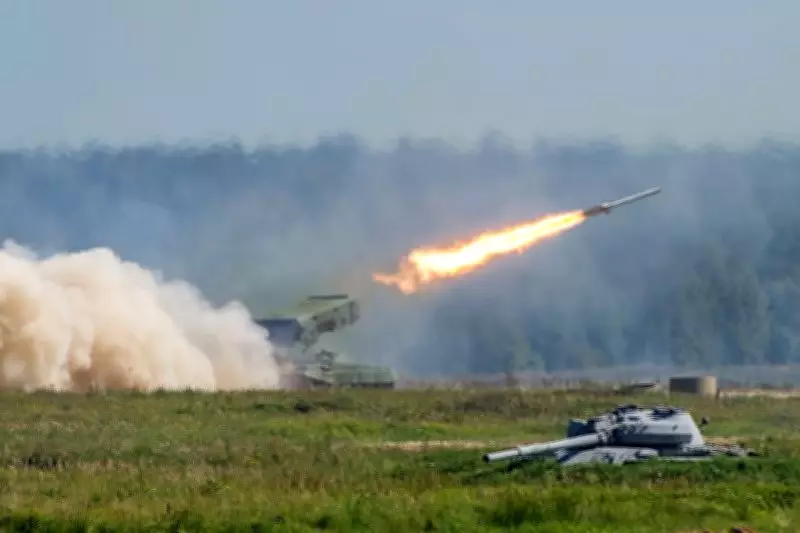
Air Marshal Narmdeshwar Tiwari (retd), former Vice Chief of Air Staff, has cautioned against India establishing a conventional rocket force, arguing that such a move would be operationally imprudent and economically burdensome. In an opinion piece, he emphasizes that ballistic missile development should remain within the strategic domain, handled by the Strategic Force Command under national leadership.
Rocket Force Debate Intensifies
The discussion around a dedicated rocket force has gained traction following the US-Iran conflict, where rockets proved effective as a deterrent. With the appointment of a new Chief of Defence Staff (CDS) and progress toward theatre commands, the timing is ripe for debate. Pakistan's announcement of a rocket force post Operation Sindoor has further sharpened focus.
In the Indian context, the proposed rocket force would handle conventional long-range ballistic missile capability. However, each service already possesses integral weapons with ranges exceeding 450 km, which are expected to increase significantly. Currently, ballistic missile capability is largely restricted to the strategic domain under the Strategic Force Command.

Drawbacks of Conventional Ballistic Missiles
The logic for a new rocket force is that India lacks credible capability to hit Chinese economic centers and targets of value, while China can target India's heartland. However, Tiwari outlines several drawbacks of using conventional ballistic missiles for long-range targeting. Ballistic missiles, even modern ones, have limited accuracy—typically 30-50 meters over 2,000-3,000 km range, relying on satellite navigation and inertial guidance, which can be jammed. To compensate for this imprecision, they carry larger warheads, leading to greater collateral damage and indiscriminate destruction.
Deployment of ballistic missiles is considered a significant escalation step and requires careful calibration. Their use in initial phases of conflict is questionable. Their predictable trajectory gives adversaries ample warning, making them easier to engage. Critically, the only difference between a conventional ballistic missile and a nuclear one is the warhead, raising the risk of accidental escalation to nuclear exchange, especially in the neighborhood.
High Costs and Limited Utility
A separate Command and Control structure would be necessary to prevent accidental use or calibrate utilization. The number of batteries required, mobility challenges for large weapon systems, and infrastructure costs for storage, manpower, maintenance, and training would be substantial. Tiwari warns that India would be saddled with a huge stockpile of conventional ballistic weapons with practically no role in limited conflicts, while establishment costs would bleed the economy indefinitely.
Alternative: Cruise Missiles and Air/Sea Platforms
Tiwari advocates for long-range cruise missiles deployed from fighter aircraft, ships, and submarines as a more precise, less escalatory, and cost-effective alternative. Air-launched weapons with ranges exceeding 800 km and cruise missiles with ranges of 1,500 km are already developed. Supersonic and subsonic cruise missiles offer greater accuracy than ballistic missiles, proven in real combat conditions. Their smaller warheads and precision make deployment less escalatory and more likely in combat, enhancing deterrence.
Maritime platforms operating in international waters (12 nautical miles off any coast) can be equipped with such capabilities, placing all important adversary targets within reach. These platforms can be easily integrated with such weapons at reasonable costs and serve multiple roles, ensuring they remain active in combat or peacetime. No new Command and Control structures are needed, as they can plug into existing Navy and Air Force targeting mechanisms. No additional cadre is required, saving revenue resources. These platforms are highly mobile, increasing operational flexibility, reach, and surprise.

Conclusion: Focus on Cruise Missiles, Not Ballistic Rockets
Tiwari concludes that development of long-range cruise missiles and their deployment from fighter aircraft and ships is a more precise, less escalatory, and more cost-effective approach. India is already well on its way to achieving this capability. Trying to set up a conventional ballistic missile force for long-range targeting would be operationally imprudent and saddle the nation with huge establishment costs of questionable value. The perceived success of the Iranian Rocket Force should not be conflated with military effectiveness; it was partly due to poor defensive posture of the adversary. Ballistic missile development should remain solely in the strategic domain.