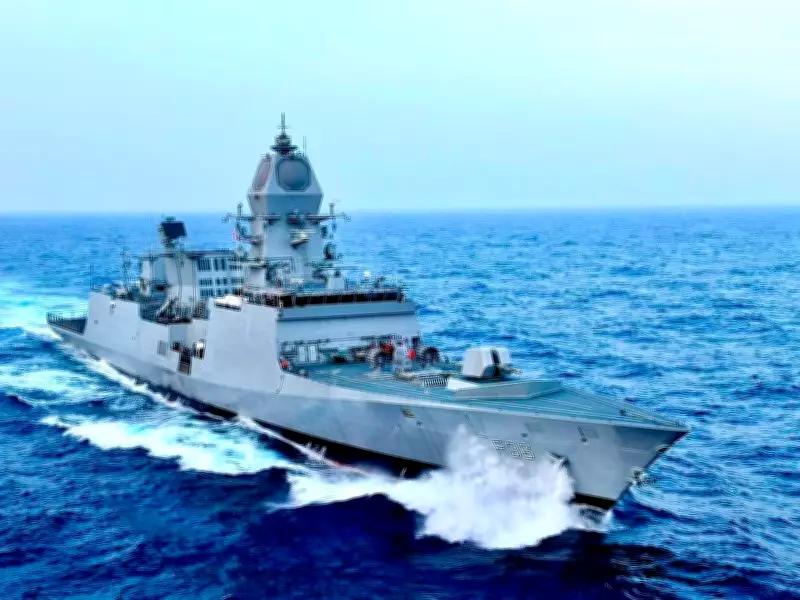
Triple Commissioning Marks Major Naval Expansion
The Indian Navy commissioned three frontline warships—INS Dunagiri, INS Sanshodhak, and INS Agray—at Garden Reach Shipbuilders and Engineers (GRSE) in Kolkata on Sunday. Each vessel has a distinct operational role, reflecting the Navy's diverse mandate. This is the second time in 2026 that the Navy has commissioned three platforms in a single day, following the January 15 commissioning of INS Surat, INS Niigri, and submarine INS Vaghsheer.
According to the Navy, 2026 is set to be the biggest year for force accretion, with 19 warships scheduled for commissioning. In 2025, the Navy commissioned 14 vessels, including a submarine. Over 24 months from January 2025 to December 2026, a total of 33 ships will be commissioned. Sources described this production tempo as unprecedented in history, demonstrating the maturity of India's domestic shipbuilding ecosystem.
PM Modi Highlights Self-Reliance and Maritime Strength
Prime Minister Narendra Modi, who presided over the commissioning event, stated that India has always considered the sea a medium of cooperation, but also recognizes that strength is essential for maintaining peace, security for safeguarding prosperity, and self-reliance for building the future. He said, "Today, INS Agray, INS Dunagiri, and INS Sanshodhak joined the Indian Navy, symbolising this spirit. They symbolise an India that recognises its potential in the 21st century, believed in its capabilities, and was constantly moving forward with renewed confidence and determination, brimming with speed, energy, and resolve before the world."

INS Dunagiri: Blue Water Frigate with Advanced Capabilities
INS Dunagiri is the fifth of seven ships in the INS Nilgiri class (Project 17-A), the first class of warships built using the 'integrated construction' technique. These ships are modular, ergonomic, and built within envisaged timelines. The Nilgiri class is a follow-on to the Shivalik class of frigates and represents a generational leap in indigenous ship design, improved stealth, survivability, and combat capability.
Displacing about 6,700 tonnes, the Nilgiri class is five percent larger than its predecessor but incorporates a sleeker form with a reduced radar cross-section. Powered by Combined Diesel or Gas (CODOG) propulsion plants, these ships achieve higher speeds and improved fuel efficiency. The weapon suite includes supersonic surface-to-surface missiles, medium-range surface-to-air missiles, a 76 mm MR gun, and close-in weapon systems. The land-attack version of BrahMos missiles is also integrated. Rigorous sea trials validated hull, machinery, firefighting, navigation, and communication systems, ensuring operational readiness.
Integrated Construction and AI-Driven Shipbuilding
The Nilgiri class uses 'integrated construction', where parts of the ship—hull, superstructure, and internal systems—are built in blocks of 250 tonnes each. These blocks are precision-fabricated to allow seamless welding of cabling and piping. Artificial intelligence provides sequences for assembling the warship, including material sourcing and production timelines. Indian shipyards now produce a ship in six years, down from the earlier eight to nine years.
The Naval Warship Design Bureau introduced latest technology, new design software, AI, and modern construction techniques. The design bureau uses software to predict a ship's turning radius, sailing ability, infra-red signature, sustainability, and power requirements. Equipment layout, machinery, and fluid dynamics are also software-predicted.
INS Agray: Anti-Submarine Warfare Shallow Water Craft
INS Agray is the fourth ship of the INS Arnala class, designed as an anti-submarine warfare shallow water craft (ASW-SWC). Built by GRSE in partnership with L&T, the ship is capable of detecting enemy submarines in shallow waters. The Navy is acquiring 16 such ships at a cost of nearly Rs 13,000 crore, with Cochin Shipyard Limited and GRSE each constructing eight.

Primary roles include detecting, tracking, and prosecuting enemy submarines in coastal and shallow waters. The ship is equipped with advanced underwater sensors such as the hull-mounted sonar Abhay, underwater acoustic communication system, and low-frequency sonar. The weapon suite includes lightweight torpedoes, rockets, anti-torpedo decoys, and mine-laying capabilities. The INS Arnala class ships are 77.6 meters long, with a gross tonnage of over 1,490 tonnes. They incorporate more than 80 percent indigenous content and involve over 55 MSMEs, promoting domestic industry.
INS Sanshodhak: Survey Vessel for Hydrographic Mapping
INS Sanshodhak is the last of four 'survey vessel large' ships, alongside INS Ikshak, INS Sandhayak, and INS Nirdeshak. These ships generate hydrographic data critical for naval operations and commercial applications. Displacing about 3,400 tonnes and measuring 110 meters in length, the ship has over 80 percent indigenous content.
Equipped for full-scale coastal and deep-water hydrographic survey, INS Sanshodhak can determine navigational channels for submarines and underwater unmanned vessels. It collects oceanographic and geophysical data for defense and civil applications, such as seabed mapping for critical minerals. The ship features state-of-the-art hydrographic equipment, including data acquisition systems, autonomous underwater vehicles, remotely operated vehicles, long-range positioning systems, and digital side-scan sonar.
Powered by two diesel engines, the ship achieves speeds over 18 knots and can accommodate 231 personnel. It carries four survey motorboats and an integral helicopter. The Navy's survey vessels are also in demand by other countries; one recently provided hydrographic assistance to Mauritius and Vietnam, while another deployed to Singapore, Philippines, Indonesia, and Malaysia, showcasing India's hydrographic capabilities.